The Honours Three
By JOHN STIRLING
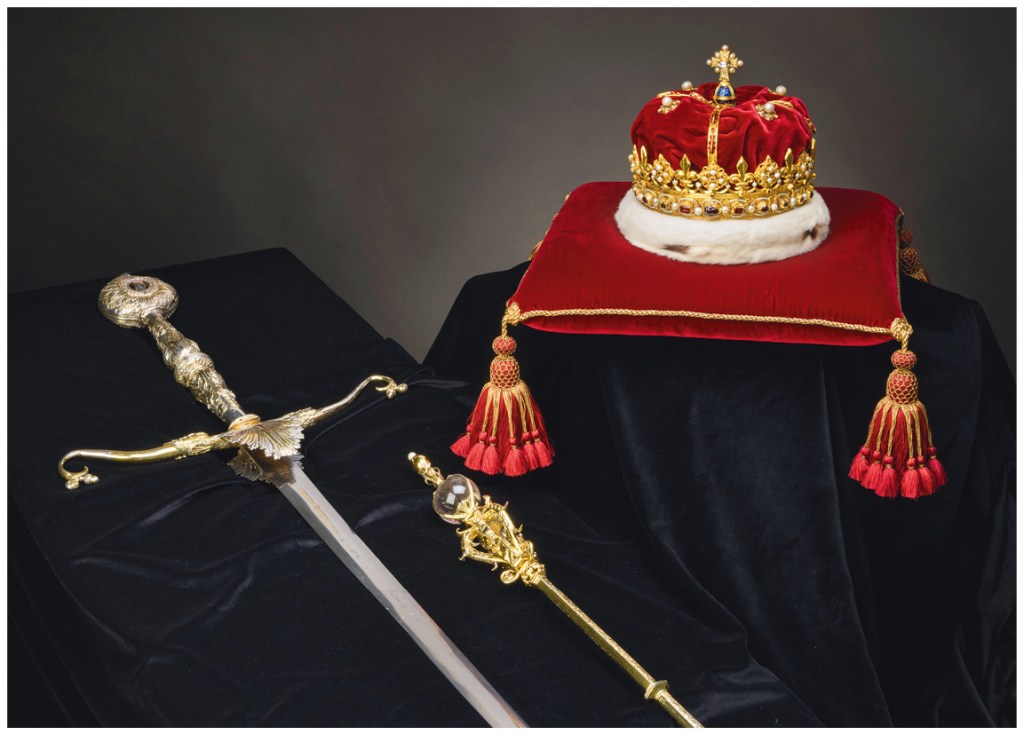 At the festive season of the year many
a toast is pledged “Wi' a the Honours Three,”
often by those who are unaware of the true
significance of the phrase.
It may be interesting to not a few to
learn something of how the Regalia of Scotland
was saved at Dunottar Castle, and how a woman's
pluck and coolness prevented the Crown, the
Septre, and the Sword—“The Honours Three”—from
falling into the hands of the Republican Soldiers.
At the advent of the Union, it was
confidently believed by many English statesmen
that the Scottish Regalia would be conveyed
to the Tower of London. This did not take
place, however, for the Regalia—consisting
of Crown, Septre, and Sword—were placed
in a large wooden chest, and deposited in
the Crown Room of Edinburgh Castle.
In 1650, after being used at the
Coronation of Charles II., the national symbols
were removed, for greater safety, to the Earl
Mareschal's Castle, of Dunottar, at Stonehaven,
in Kincardineshire. At this time, however, the
Earl was a prisoner in England, and the defence
of the Castle was entrusted to his friend,
Captain George Ogilvie, of Barras, when
Cromwell's soldiers advanced northwards.
This same Captain had a garrison of
100 men—all stout fellows—and attached to
their commander—for whom they would have
laid down the lives; but Captain Ogilvie
well knew that if it came to an attack, his
little band would never be able to stand
out against the force which Cromwell would
send against him.
In order to preserve “Scotland's Honours
Three,” it was determined to resort to strategy.
On the advice of the Dowager Countess Mareschal,
Mrs Granger, wife of the Rev. William Granger,
minister of Kineff, asked permission of the
English Commander to pass through his lines, in
order to visit the Governor's wife (Mrs Ogilvie)
in the Castle. The request was granted, and
Mrs Granger and her maid paid a short visit
to Dunottar Castle.
On returning they each carried a parcel;
but as it was thought that it was merely
some present they had got from the Governor's
wife, no notice was taken of it. In fact,
Major-General Gordon, who commanded the
besieging army, very politely assisted
Mrs Granger to mount her horse, whilst she
was carrying in her lap the Scottish Crown
tied amongst a lot of clothes. The ladies,
after covering some distance in a slow and
decorous manner, so as not to create suspicion,
finally fled as fast as possible to the
manse of Kineff—about five miles distant.
The purpose of the visit is best told by
a letter which the minister himself supplied
to the Dowager Countess:—
At the festive season of the year many
a toast is pledged “Wi' a the Honours Three,”
often by those who are unaware of the true
significance of the phrase.
It may be interesting to not a few to
learn something of how the Regalia of Scotland
was saved at Dunottar Castle, and how a woman's
pluck and coolness prevented the Crown, the
Septre, and the Sword—“The Honours Three”—from
falling into the hands of the Republican Soldiers.
At the advent of the Union, it was
confidently believed by many English statesmen
that the Scottish Regalia would be conveyed
to the Tower of London. This did not take
place, however, for the Regalia—consisting
of Crown, Septre, and Sword—were placed
in a large wooden chest, and deposited in
the Crown Room of Edinburgh Castle.
In 1650, after being used at the
Coronation of Charles II., the national symbols
were removed, for greater safety, to the Earl
Mareschal's Castle, of Dunottar, at Stonehaven,
in Kincardineshire. At this time, however, the
Earl was a prisoner in England, and the defence
of the Castle was entrusted to his friend,
Captain George Ogilvie, of Barras, when
Cromwell's soldiers advanced northwards.
This same Captain had a garrison of
100 men—all stout fellows—and attached to
their commander—for whom they would have
laid down the lives; but Captain Ogilvie
well knew that if it came to an attack, his
little band would never be able to stand
out against the force which Cromwell would
send against him.
In order to preserve “Scotland's Honours
Three,” it was determined to resort to strategy.
On the advice of the Dowager Countess Mareschal,
Mrs Granger, wife of the Rev. William Granger,
minister of Kineff, asked permission of the
English Commander to pass through his lines, in
order to visit the Governor's wife (Mrs Ogilvie)
in the Castle. The request was granted, and
Mrs Granger and her maid paid a short visit
to Dunottar Castle.
On returning they each carried a parcel;
but as it was thought that it was merely
some present they had got from the Governor's
wife, no notice was taken of it. In fact,
Major-General Gordon, who commanded the
besieging army, very politely assisted
Mrs Granger to mount her horse, whilst she
was carrying in her lap the Scottish Crown
tied amongst a lot of clothes. The ladies,
after covering some distance in a slow and
decorous manner, so as not to create suspicion,
finally fled as fast as possible to the
manse of Kineff—about five miles distant.
The purpose of the visit is best told by
a letter which the minister himself supplied
to the Dowager Countess:—
“I, William James Granger, minister of
Kineff, grant me to have in my custody
the Honours of the Kingdom, namely,
the Crown, Septre, and Sword. For the
Crown and Septre, I raised the pavement
stone, just before the pulpit, in
the night time, and digged under it one
hole, and layed down the stone, just as
it was before, and removed the mould
that remained, that none could have
discovered the stone to have been removed
at all.
“The Sword, again, at the west end of the
Church, amongst some common seats
that stand there, I digged down in the
ground, betwixt the two foremost of
these seats, and layed it down at the
side of them, and covered it up so that
by removing the superfluous mould it
could not be discovered by anybody.
“And if it shall please God to call me to
death, before they be called for, your
Ladyship will find then in that place.
—William James Granger, 31st March,
1652.”
On the surrender of the Castle to
Cromwell's soldiers, and when it was found that
Captain Ogilvie, the Lieutenant-Governor,
or his lady, could or would give no account
of the Regalia, they were treated with great
severity, being dragged from one prison to
another.
Captain Ogilvie's wife died two years
later, attributed no doubt partly as the result
of the treatment she received, and she
enjoined her husband on her deathbed to
preserve the secret.
In order to throw Cromwell's soldiers
on to a wrong track, the Countess Mareschal
circulated a report that the Regalia had
been taken to Paris by her son, the Hon. Sir
John Keith, and delivered to Charles II.,
and on that young gentleman's return to
Scotland he supported his mother's story,
although his life was in danger.
The faithful clergyman and his wife
from time to time secretly lifted the jewels
and wrapped them anew in cloth, lest they
should become tarnished by damp, and this
they did, though suspicion at one time fell
upon them. It is also said that they were
tortured in order to get them to confess.
At the Restoration, in 1660, the Regalia
were lifted and restored to Charles II. Sir
John Keith was created Earl of Kintore, and
Captain Ogilvie, the Lieutenant-Governor
of Dunottar, was made a Baronet.
The brave wife of the minister of Kineff
was not forgotten, and was rewarded with
a grant of 2000 merks Scot. A merk, I may
say, is an old Scottish silver coin, worth 1s
1d in our present day money—2000 merks
at that time was considered a large sum of
money.
The “Honours Three” were then returned
to their former resting place of keeping, in
the Crown Room of Edinburgh Castle, where
they were lost trace of for a long period
of years—namely, till the year 1818.
Prior to the period when the National
Records were kept in the Register House,
they were secured in hogs-heads in what was
known as the Laigh Parliament House, the
northern wall of which bordered the damp
earth of St. Giles' Churchyard.
Many volumes, through gross carelessness,
went amissing about this time. At last a royal
warrant was obtained to visit the Throne Room
to see what volumes were still intact. In the
course of the search there was found, in an
arched chamber, and resting under several inches
of dust, a large oaken chest. Everyone was
anxious to know what it contained; and as the
public mind was uneasy to know about the Regalia,
Sir Walter Scott, who was a great friend of the
then Prince Regent, obtained leave to make a
thorough search. This took place on 4th February,
1818.
No key being found to fit the lock of
the chest referred to, the King's smith, who
was in attendance, was commanded to force
open the lid of the great chest.
The general impression that the Regalia
had been secretly moved weighed heavily on the
hearts of those present. While the labour
proceeded the chest seemed to return a hollow
and empty sound to the strokes of the hammer.
Even those, whose expectation had been most
sanguine, felt the probability of bitter
disappointment, and could not but be sensible
that, should the result of the search confirm
their forebodings, it would serve to show that
a National affront—an injury—had been sustained,
for which it might be impossible to obtain redress.
The joy was extreme when the ponderous
lid of the chest, having been laid open, at
the expense of great labour, the Regalia—the
Crown, the Septre, and the Sword of
State—were discovered lying at the bottom
covered with linen cloths, exactly as they
had been left in 1707—being 111 years—since
they had been surrendered by William, the
ninth Earl Mareschal, to the custody of
the Earl of Glasgow, Treasurer-Deputy of
Scotland.
The discovery caused much excitement
and extreme joy, and was instantly
communicated to the public by the display of
the Royal Standard, and was greeted by
the shouts of the soldiers in garrison and a
vast multitude assembled on the Castle Hill.
Indeed, the rejoicing was so general and
sincere as plainly to show that the people of
Scotland had lost nothing of their national
enthusiasm.
With the exception of the Sword, which
was slightly bent, all the other Honours were
in a good state of preservation.
Covered with glass and secured in a
strong iron cage, the Regalia now lie on
a white marble table in the Crown Room,
toether with four other memorials of the
House of Stuart, which belonged to the
venerable Cardinal York, and were deposited
there by order of King William in 1830.
Bathgate, I may say in passing, is the
cradle of the Stuart race, they having resided
in the old Castle of Bathgate, which was
situated some four hundred yards from the
Bathgate Upper Station, on the present golf
course.
In the year 1315 the High Steward of
Scotland came into possession of the Castle,
through his marriage with Princess Marjory,
only daughter of King Robert the Brice, and
was his favourite residence.
From the union sprung the Stuart line
of Kings. Marjory Bruce was the “lass”
referred to by James V. on his deathbed:
When he heard of the birth of Mary Queen
of Scots, he said—“Farewell: it cam' wi' a
lass, it will gang wi' a lass.”
The memorials referred to in connection
with the House of Stuart are the Golden
Collar of the Garter, presented to James
VI. by Elizabeth, with its appendage the
George; the Order of St. Andrew, cut on an
onyx, and having on the reverse the Badge
of the Thistle, which opens with a secret
spring, revealing a beautiful miniature of
Anne of Denmark; and, lastly, the ancient
Ruby Ring which the Kings of Scotland
wore at their coronation: it was last used
by the unhappy Charles I., and, after all its
wanderings with his descendants, is now in
its old receptacle together with the Crown,
Septre, Sword of State, and the Golden
Mace of the Lord High Treasurer. Inspired
with enthusiasm, Mr Henry Scott Riddell
wrote the song “Scotland Yet.” The song
proved very popular. The spirited music to
which it is sung was composed by Mr Peter
Macleod, and was first published by him
in a separate sheet, the profits being given
for the purpose of putting a parapet round
the monument of the National Bard on the
Calton Hill; in connection with which Mr
Joseph Teenan, a now forgotten Edinburgh
poet, composed the Couplet—
“Puir Burns, amang the Calton rocks,
Sits lanely in his pepper box!”
Mr Henry Scott Ridell, the Scottish
Poet Preacher, was born at Sorbie-on-Ewes,
near Langholm, in the year 1798, and died
in 1870. He was first a shepherd, and afterwards
educated for the ministry; he settled in
1833 at Teviothead, Roxburghshire, and
retired in 1841 from the ministerial office.
His best known songs are “Scotland Yet,”
“The Crook and the Plaid,” and “The Wild
Glen Sae Green.”
It may not be amiss to give you a short
description of the Regalia.
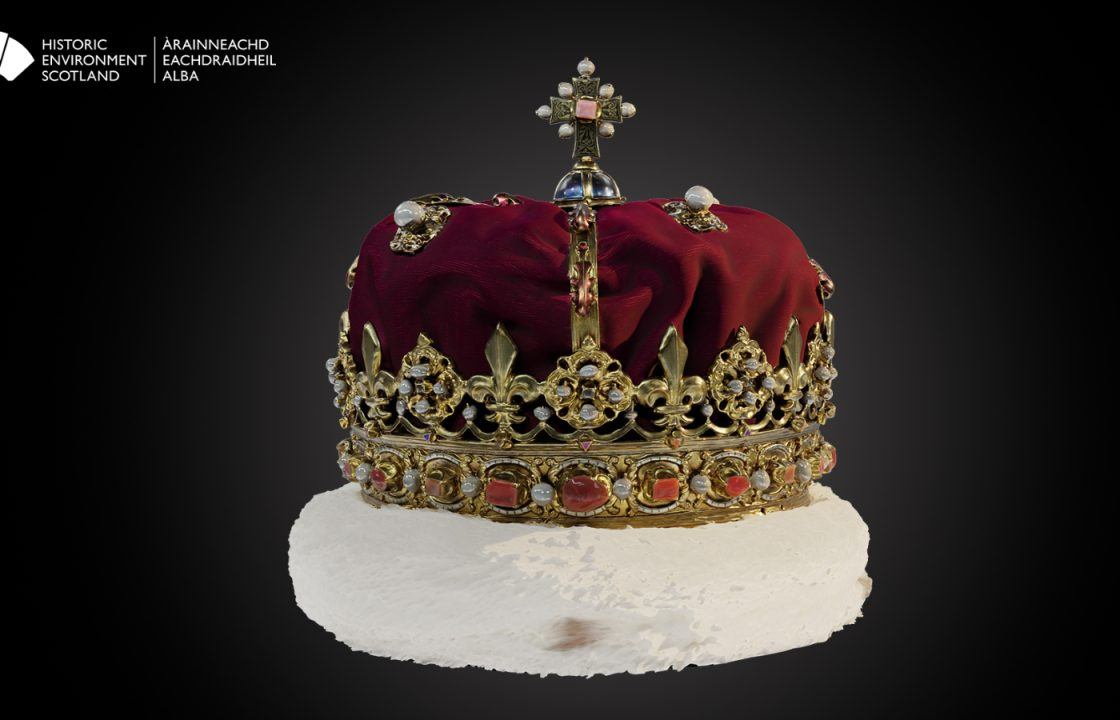 The Crown is of pure gold, enriched
with many precious stones, diamonds, pearls,
and curious enamellings. It is composed of
a fillet which goes round the head, adorned
with twenty-two large precious stones. Above
the great circle there is a small one formed
with twenty points, adorned with a like
number of diamonds and sapphires alternately,
and the points tipped with great pearls;
the upper circle is elevated with ten crosses
floree, each adorned in the centre with a
great diamond between four great pearls
placed in the cross, and these crosses
floree are interchanged with ten high
fleurs-de-lis.
From the upper circle proceed four
arches, adorned with enamelled figures,
surmounted by a mond of gold, enamelled blue
semee, powdered with stars, crossed and
enamelled with a large cross patee, adorned
with great pearls.
The tiar, or bonnet, was originally of
purple velvet; but, in 1685, it got a cap of
crimson velvet, adorned with four plates of
gold, on each of them a great pearl, and the
bonnet is trimmed with ermine.
The Crown is 9 inches in diameter, 27
inches in circumference, and 6½ inches high.
The Crown is of pure gold, enriched
with many precious stones, diamonds, pearls,
and curious enamellings. It is composed of
a fillet which goes round the head, adorned
with twenty-two large precious stones. Above
the great circle there is a small one formed
with twenty points, adorned with a like
number of diamonds and sapphires alternately,
and the points tipped with great pearls;
the upper circle is elevated with ten crosses
floree, each adorned in the centre with a
great diamond between four great pearls
placed in the cross, and these crosses
floree are interchanged with ten high
fleurs-de-lis.
From the upper circle proceed four
arches, adorned with enamelled figures,
surmounted by a mond of gold, enamelled blue
semee, powdered with stars, crossed and
enamelled with a large cross patee, adorned
with great pearls.
The tiar, or bonnet, was originally of
purple velvet; but, in 1685, it got a cap of
crimson velvet, adorned with four plates of
gold, on each of them a great pearl, and the
bonnet is trimmed with ermine.
The Crown is 9 inches in diameter, 27
inches in circumference, and 6½ inches high.
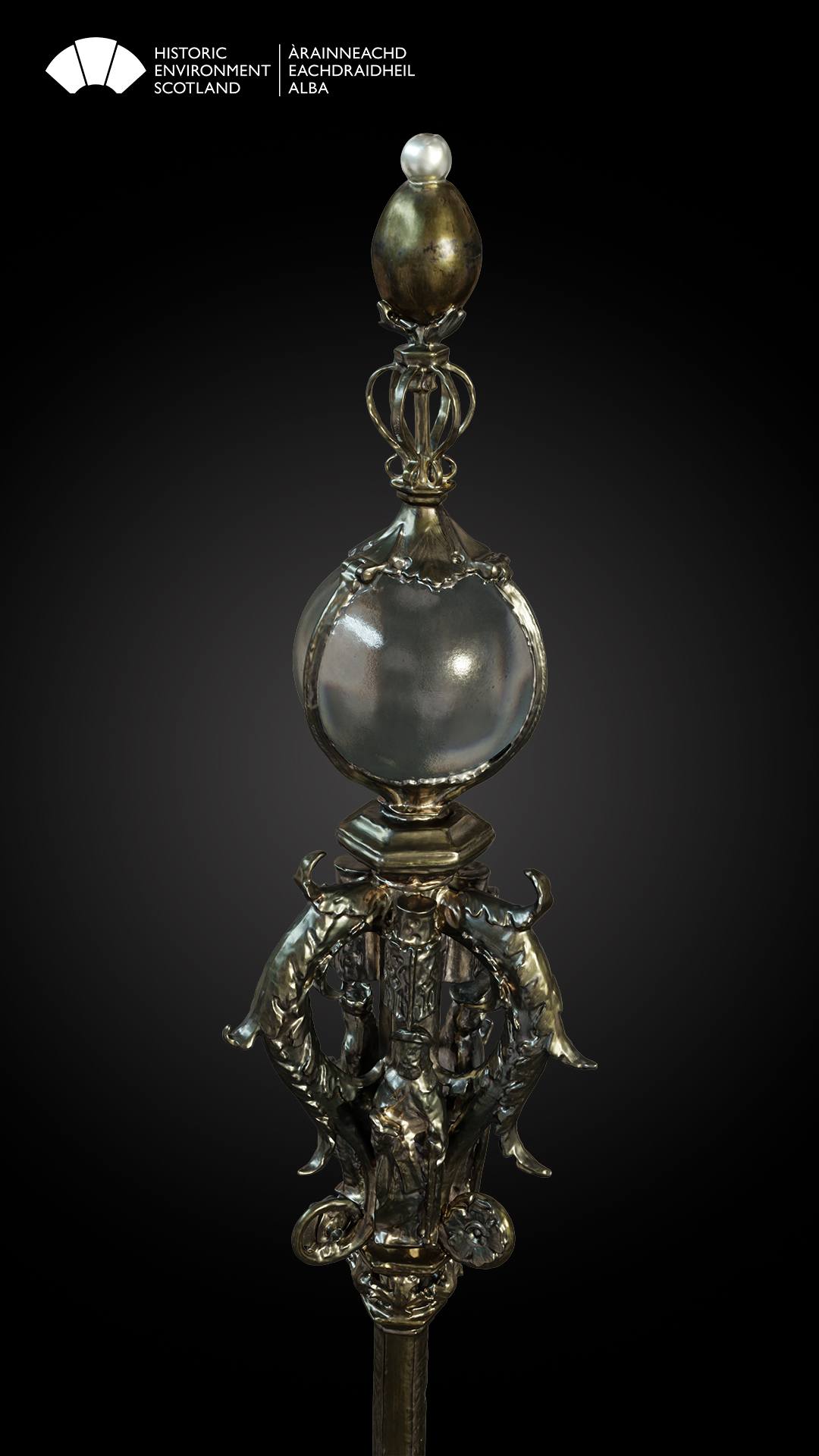 The Septre, which is of silver double
over-gilt, is two feet long, of a hexagon
form, with three buttons or knobs. Upon
the top of the stalk is an antique capital
of leaves embossed, surrounded with three
small statues—the Virgin, St. Andrew, and
St. James.
The Septre, which is of silver double
over-gilt, is two feet long, of a hexagon
form, with three buttons or knobs. Upon
the top of the stalk is an antique capital
of leaves embossed, surrounded with three
small statues—the Virgin, St. Andrew, and
St. James.
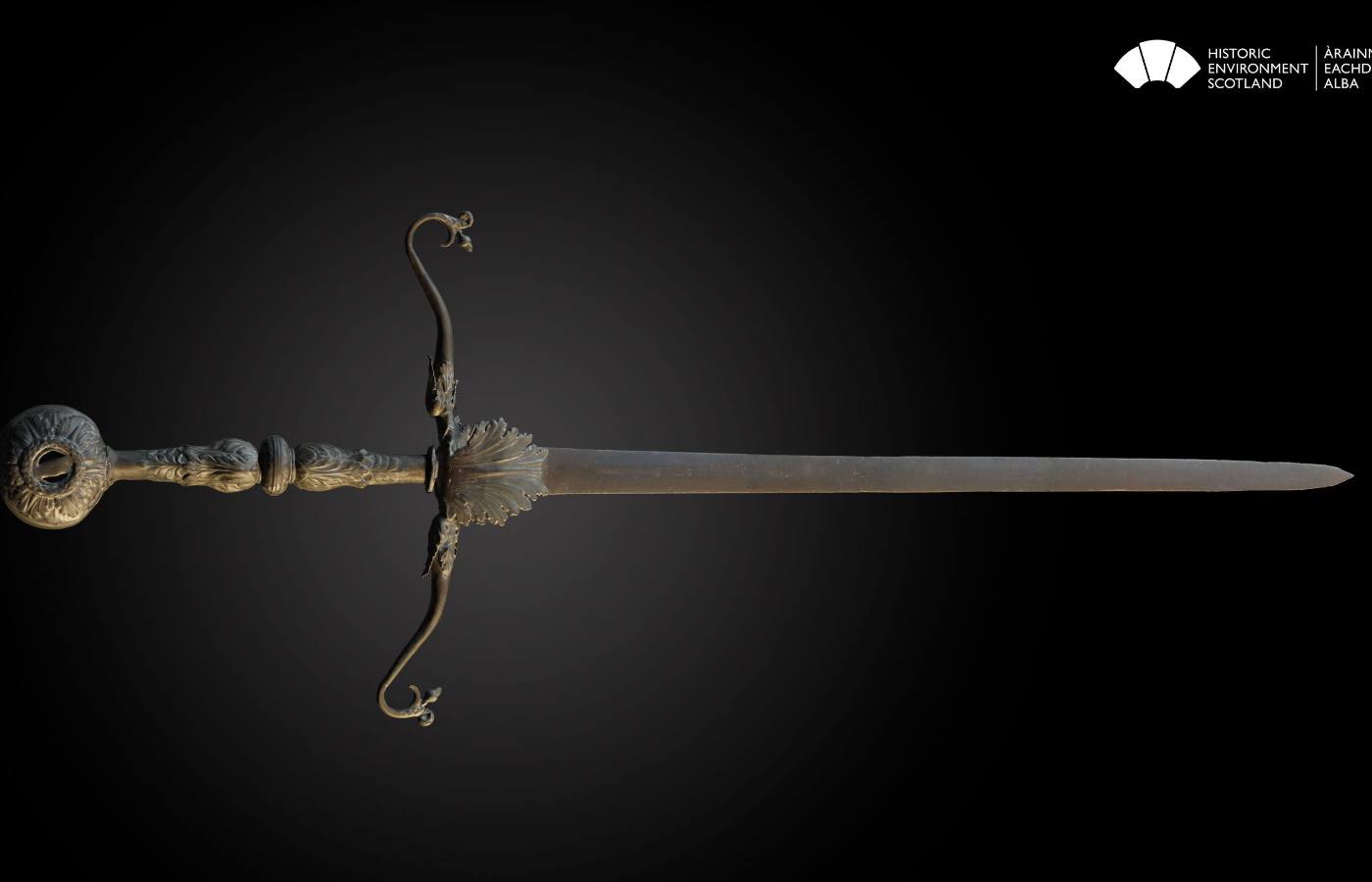 The Sword is 5 feet in length: the
handle and pommel are of silver overgilt,
in length 15 inches; the cross of the sword
is 17½ inches in length: its form is like two
dolphins with their heads joining and their
tails ending in acorns. The scabbard is of
crimson velvet, covered with silver wrought
in philegram work into branches of the oak
tree leaves and acorns.
Such are the Scottish Regalia, which,
since the destruction of those of England
by Cromwell, are the only ancient regal
emblems in Great Britain.
In concluding, let me say that I have
endeavoured to give you an explanation of
the term—“Wi' a' the Honours Three.”
The Sword is 5 feet in length: the
handle and pommel are of silver overgilt,
in length 15 inches; the cross of the sword
is 17½ inches in length: its form is like two
dolphins with their heads joining and their
tails ending in acorns. The scabbard is of
crimson velvet, covered with silver wrought
in philegram work into branches of the oak
tree leaves and acorns.
Such are the Scottish Regalia, which,
since the destruction of those of England
by Cromwell, are the only ancient regal
emblems in Great Britain.
In concluding, let me say that I have
endeavoured to give you an explanation of
the term—“Wi' a' the Honours Three.”
______________
The following are the full words of the
song—
SCOTLAND YET.
Gae bring my guid auld harp aince mair,
Gae bring it free and fast;
For I maun sing anither sang
Ere a' my glee be past.
And trow ye as I sing, my lads,
The burden o't shall be,
Auld Scotland's howes and Scotland's knowes,
And Scotland's hills for me;
I'll drink a cup to Scotland yet,
Wi' a' the Honours Three.
The heath waves wild upon her hills,
And, foaming frae the fells,
Her fountains sing o’ freedom still
As they dance down the dells.
And weel I lo’e the land, my lads,
That’s girded by the sea;
Then Scotland’s dales, and Scotland’s vales,
And Scotland’s hills for me;
I’ll drink a cup to Scotland yet,
Wi a’ the Honours Three.
The thistle wags upon the fields,
Where Wallace bore his blade,
That her foemen’s dearest bluid
To die her auld grey plaid.
And looking to the lift, my lads,
He sang this doughty glee,
Auld Scotland’s right, and Scotland’s might,
And Scotland’s hills for me;
I’ll drink a cup to Scotland yet,
Wi’ a’ the Honours Three.
They tell o’ lands wi’ brichter skies,
Where freedom’s voice ne’re rang;
Gie me the hills where Ossian dwelt,
And Coila’s minstrel sang;
For I’ve nae skill o’ lands, my lads,
That ken na to be free;
Then Scotland’s right, and Scotland’s might,
And Scotland’s hills for me;
We’ll drink a cup to Scotland yet,
Wi’ a’ the Honours Three.