______
In the Words of My Father
______Martin George Johnston
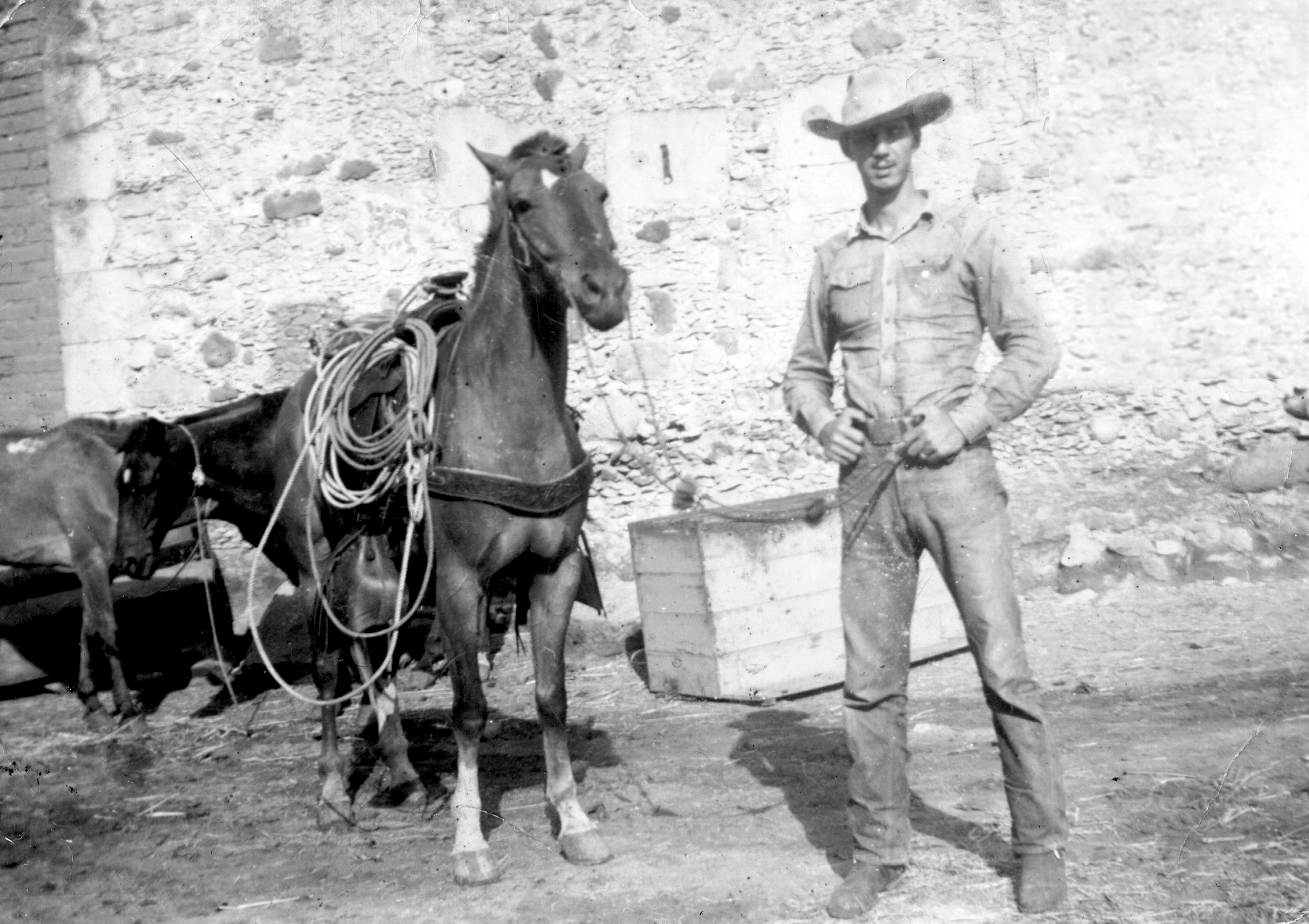
My father was born on Panchita Ranch, just north of La Villa. Panchita Ranch was the official name of the ranch that we owned; it was named after my grandmother, whose name was Francisca Hinojosa. Prior to its name change, the ranch was called El Senisal, but the Anglos couldn’t pronounce it, so my grandfather changed its name to Panchita. Even then, the Anglos pronounced it, “Pancheetuh.”
My grandfather, Frederick Johnston, married my grandmother in 1896. We have been told that the Johnstons were originally from the Scottish Johnstons; others have said that they were Irish. From what I understand, my great-grandfather George Johnston, from Orange, Texas, came to the area as a twenty year-old in 1860. He used to tell me that our name was Scotch-Irish.
My granddad had a contract for clearing brush in the area around Panchita Ranch. Since there were no bulldozers at the time, people had to clear the mesquite, cactus and brush by hand. Granddad had a lot of families from Mexico working and living in the area so he asked the post office department to set up a post office on the ranch. Everyone, including Mexican workers, got their mail there. In fact, in 1915, my granddad asked the U.S. Cavalry for protection for the post office.
Its 1915, during the bandit troubles here in the Valley; and in those days, there was a lot of jealousy among ranchers. Somebody had accused Granddad, in a whispering type campaign, that he was a bandit sympathizer. You see, my granddad also had a store in Panchita and someone accused him of selling ammunition to the bandits. The story I was told was that the Texas Rangers wanted to take Granddad out for questioning, which in those days, a questioning by the Rangers was like a death sentence. My grandfather was not scared of the bandits; it was the Texas Rangers that scared him. So he asked the U.S. Cavalry out of Fort Brown (Brownsville) to come out to the ranch and protect the post office, but they also protected him from the Rangers.
My grandfather was bilingual and bicultural. He was at one time a schoolteacher. He established a school for Spanish-speaking youngsters in Mercedes. He was also a teacher at the San Jose Ranch. There was also a school at Panchita Ranch, and from what I’ve heard, all of Hidalgo County was a single common school district. Come to think of it, a Ms. Maria Villarreal was a schoolteacher at the Panchita School in the 1920’s. She married my dad’s cousin, Salvador Solis. They lived right before you cross the bridge going east, across the canal. And on the right side of that levee is where the schoolhouse used to sit.
I started attending the first grade at La Villa in 1932, and I went there until I was in the third grade. When it rained, the roads became muddy and there was no bus going out to Panchita to pick up the kids. Panchita was only about three or four miles from La Villa. Some of the older boys had horses to get to school when it was raining. I used to ride in the back of the saddle with one of the guys that would give me a horseback ride to school.
I believe that the older boys were more interested in riding their horses and showing off than they were in school.
Eventually my mother decided to send us to the schools in Mercedes. We still had the ranch at Panchita, but my father had moved our ranch house to La Villa. It was then that my mother sent us to Mercedes. Mercedes had good schools, but I preferred to be at Edcouch-Elsa because most of my friends were attending school there. During the summers and on weekends, we worked out in the fields, we worked with cattle, and we were always messing around with horses. After the tenth grade I came back to Edcouch-Elsa and right before I graduated, I dropped out and joined the navy during World War II.
We had well over 300 acres at Panchita Ranch, and my granddad leased a lot of other land. In fact, I would be safe to say that from Mile 18 north and northeast, he had ranch holdings all the way up to present-day Stockholm, Texas. Panchita Ranch originally belonged to my great-grandfather, Martin Hinojosa del Toro. I was named after him and after my great-grandfather, George Johnston. When great-grandfather Martin Hinojosa died, the land then belonged to his wife, my great-grandmother, Crisanta Solis Hinojosa. Somehow, my grandfather got grandmother, Panchita Johnston, to talk great-grandmother Hinojosa into giving grandmother her share of the land. After grandmother got her share, my grandfather took it and invested and developed it. The area north of Panchita, known as the Johnston-Young tract, was developed by my grandfather. Before it became the Johnston land, it was part of the Juan Jose Hinojosa Llano Grande Tract. He controlled about a thousand acres in the area, puro monte. When I was young, I got to ride out there.
After we moved to La Villa and I started attending school in Mercedes, I actually lived with my aunt and my grandmother in Mercedes. We lived in a kind of replica of the ranch house that we had at Panchita, although it was not as big. My grandfather built that house in 1912, and it still stands; it’s located at 205 Georgia in Mercedes. Every weekend I would hitch hike to the ranch so I could go hunting. To this day, I am a fiend at hunting.
I came back to Edcouch-Elsa after the tenth grade. I loved it there; they were country folks, just like me. Edcouch-Elsa just had a different atmosphere than Mercedes. There was more of an interracial mix at Edcouch-Elsa High School. A lot of the guys spoke Spanish.
We were always riding horses together; in fact, if I missed the bus to school in the mornings, I would saddle up my horse and ride him to school. I’d be at school in about twenty minutes, drop off my saddle and tack at the F.F.A. barn and stake my caballo to the canal. In the afternoon, I’d saddle him up and ride him back home. I usually beat the kids that rode the bus home.
Incidentally, the Anglo kids that lived in La Villa never went to school in La Villa. They went to the elementary school in Edcouch. After I got back from the Navy in ’46, the Anglo kids were going to school in Mercedes.
I may have been a dropout, but at Edcouch-Elsa is where I learned to type. When I went into the service, I was not able to get into one of the trade schools that they had promised me because I did not qualify. I had taken some sort of achievement test, but I did not score high enough. One day I read in the ship newspaper that if you could type you were to report to the chief something or other. So I reported and he asked me to type something. I typed about two or three words of a paragraph and he said I’d do. So from there on out, I worked in the offices. I was the only enlisted man in some of the ship’s offices; the rest of the people were officers. Sometimes we’d get to talking and they’d tell me where they were from and where they’d gone to school. My experience with these men prompted me to get involved and interested in education once again. I wanted to go back to school and become a school teacher, and eventually I did become one.
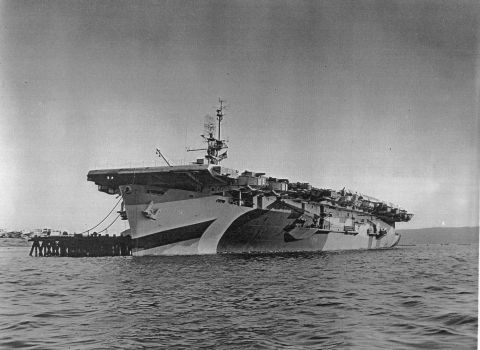
The carrier I served on was the U.S.S. Hoggatt Bay. We recently gathered for our 50-year reunion. From what I understand, the ship I served on was decommissioned back in 1946; and in 1960, it was sold to the Japanese for scrap.
While serving on my carrier, I met a few Mexican-Americans from throughout the country. I had to talk with somebody in Spanish, but there were some Mexican-Americans that did not know how to speak Spanish!
We were in the Philippines when the war was over. I was discharged from the Navy, and I came back home and took advantage of the G.I. Bill. Aside from the officers I had met in the Navy, my grandfather was a big influence in my wanting to become a school teacher. He was very fluent in English and he seemed to be very well versed. I guess I was also interested in education because in all my years of schooling, from elementary to college, not once did I have a Hispanic for a teacher. I felt I could make a difference.
I went to school all my life; I taught school all my life. Yet, I got all that psychology, much of what I know, I learned from the old men by listening to their advice on how people behave and on what causes people to do things. I’d study behavioral science and I’d say, “Hey, where did I hear that?” I heard it out there in the fields from people who couldn’t even speak English, much less read or write.