Letter-by-Letter Word Games FAQ


This is a resource of the wordgame-programmers@egroups.com mailing list.


Click to subscribe to wordgame-programmers

Compiled by Graham Toal and Steffan O'Sullivan

This is an attempt to list the letter-by-letter word games that have been published -- called "letter-by-letter games", or "word-building games", to distinguish them from word games which use whole words, phrases, sentences, etc. Examples of the latter include Taboo, Guestures, Trivial Pursuit, and Charades; all of which can be considered "word games", but are outside the scope of this list. Instead, this list focuses on games in which the basic element is a letter, and words are built up from there. We will also not be listing traditional word games which can be played without special equipment, although many of the games here could also be played without the paraphenalia listed here (typified by Jotto, for example); To include pencil and paper word games would turn this project from a web page into a book! Similarly we will also be avoiding purely electronic word games (such as Jumble) unless they also have a board, card or tile component.

ScrabbleTM is probably the best-known letter-by-letter word game today. Many of the games below were invented to cash in on the popularity of Scrabble; but many of them pre-date it, especially the games using lettered cards and letter-dice, and one game in particular - Pressman's Wordy (copyright 1938) - may well turn out after a little detective work to be the original inspiration for Scrabble (copyright 1948).

The games currently listed are mostly from the USA with some from other English-speaking lands such as Britain and Australia, but submissions of games from other countries and for play in other languages will be most welcome. (Here's a good list from France that I haven't yet had time to go over individually) We hope to eventually document all aspects of a game, so that if you are going to buy one (on eBay, for example) you'll be able to check here and see just how many tiles or cards there should be before you buy a set with some missing items. We'll also be documenting the rules, when possible, so you can play on an old game whose original rules are lost. (Meanwhile, the Games Cabinet, About.com, D'Antiques, and the AGPC (not online - photocopies by mail only) have a fine selection of rules, and John McLeod has a huge database of rules for card games. The about.com site also has some advice for buyers. As, occassionally, do we.)

This list is not done yet - there have been an astonishing number of such games published. We'll continue to add any new submissions and corrections that are mailed to Steffan O'Sullivan <groo@groo.com>.

My thanks to the contributors (listed below), and to anyone else who responds to my plea to fill in either more game titles, comments, or both. Also thanks to external sites we've linked to, which may have a review or an image of a game. To keep the loading time of this page reasonable, I'm not placing any images inline within this page.

The games are in alphabetical order, and are numbered merely so I can easily see how many we've been able to list. If we give a date, it's the oldest date we're aware of; if we give a tile count, it's the highest tile count we're aware of - but beware, games may be older than we know or we may have info from boxes with tiles missing!

I've recently started adding some price guide information, basically just summarizing the prices fetched on eBay for the permanent record, before eBay forgets old sales. These are not to be taken with any authority. Anything you sell is worth what you can get for it. I've seen the very same game sell at times for $10 and other times for $50.

The latest major change to this page is to add some images of the games. A few words of explanation are needed here. The principle source of research for finding uncatalogued games is the online auction site, eBay. When I find a new game, I generally mail the person selling it and ask if I can use the image from their page. Usually they say yes with no strings attached. Occassionally they ask that I link to their auctions, which I'm happy to do in exchange. However most times I don't get an answer at all, which is a little depressing, though certainly understandable because many auction sellers aren't interested in what they sell - they get job lots from a house clearing when someone dies and sell everything off as fast as possible. It's a business. And I wouldn't want to put someone out who was trying to get some work done. So... although in life I'm generally very strict about copyrights and things of that nature, I have in these pages included some graphics from people from whom I have not had explicit permission. In those cases, I generally check their 'other sales' pages first, and if they are a specialist in word games, I'll include a link to it because no matter when you access it you'll probably find a word game. People who have only ever sold one word game however I don't generally link to as the word game will be long gone from the memory of eBay by the time you click on their link. In those cases I may out of politeness include a generic link to eBay, or have no attribution at all. If any ebay advertiser spots one of their scans here and is offended by this appropriation of their images, I will remove it immediately. My common sense feeling is that no-one is likely to object. I know I certainly wouldn't. Now that the page below is starting to get a pretty good coverage of what's available, new games are arriving more slowly than before and I have more time to pursue requests to include images. When I first started this page, I was adding 10 or 20 a day, and it just wasn't possible to track everyone down to ask their permission. On the plus side, we do have quite a lot of good pictures here :-)

So, without further ado, the games:

Letter-by-Letter Word Games

Compiled by Steffan O'Sullivan and Graham Toal

Quick index: [A] [B] [C] [D] [E] [F] [G] [H] [I] [J] [K] [L] [M] [N] [O] [P] [Q] [R] [S] [T] [U] [V] [W] [X] [Y] [Z]

  1. Academie by US Games Co., 1949
    A Word game with Wooden racks to hold cards. 3 minute timer, score cards, rules. Part of the "Cavendish Academie System Part 1." Registered U.S. Patent Office and Copyrighted in Great Britain and the Dominions. Cards have two letters on them, differing letters on opposite corners. Word point value table: For winning round with 1 word: 30, 2 words: 21, 3 words: 10; Plus Value of Words of 2-3 letters: 1, 4 letters: 2, 5:4, 6:7, 7:11, 8:16, 9:22, 10:30, 11:40, 12:52, 13:68, 14:90, 15-16 letters: 120. Extras: 3 of a kind: 15, 4 of a kind: 25, Two word couplets: 10
  2. Accent by Radio Printing Corporation, 1954
    No details of this game at all, not even 100% sure of the name. Radio Printing Corporation of Bridgeport, Conn. The game board looks Scrabble-like, but the point of the game is to play words which rhyme with something. Not sure what!
  3. Add a word
    See
    Funagain Games
  4. Ad.dic.tion by Createk Inc, 1968
    Players attempt to form words WITHOUT completing them. The one who DOES complete a word is the loser. Bluffing is part of the game, but can be costly for the player whose bluff is discovered.
  5. Addiction by Waddington's House of Games, Bramalea (On), 1979
    Solo or with any number of players. The box contains 13 dice with scored letters on their sides (yet another
    Scribbage clone) and a playing surface consisting of a 5x5 grid and a dice chute.
    Each die is rolled and must then be placed in the grid; the object is to build words in the grid crossword-fashion; all words must be linked to score --any unlinked cubes at the end of the round are removed. Game is played in 300 points. [DUT] [SOS] Note that this is an interesting half-way house in the development of dice games. Until now, most dice games - even ones which required solutions laid out interlocking crossword fashion - we simply spilled on your table or carpet. This game constrains the solutions to a 5x5 board (which also forces a higher degree of interlocking than say a single 8 letter word intersecting a 6 letter word). In some way it is almost a miniature Scrabble. Note that the dice have point values, also like Scrabble. This is about as close to a hybrid of dice games and board games as you can get.
  6. Ad Lib published by ES. Lowe, 1975
    This appears to be a renaming of
    Scribbage in response to a lawsuit from the trademark owners of Scrabble.
    The faces of the 13 dice are: [V N U O C K] [Q A I F L G] [W V A D T E] [H R E N O T] [O W U M P Y] [A S X E B Y] [E R I S D BLANK] [D J N A R E] [Z A I F C E] [M P BLANK G E I] [S B N M U O] [A S E L T H] [O E L I R T]
    The scores on the letters are: A 1 B 4 C 4 D 3 E 1 F 4 G 4 H 3 I 2 J 6 K 5 L 2 M 3 N 2 O 1 P 4 Q 8 R 2 S 2 T 2 U 3 V 4 W 4 X 8 Y 4 Z 10 BLANK 0
    [poor quality image]
  7. Duplicate Ad Lib by E.S. Lowe.
    Variant of
    Ad Lib for two players. The version I have has each player with one's own gameboard and letter dice trying to make the highest possible set of scoring crosswords. Each player secretly records one's own play then, after shuffling the order of the letters, but not changing the positions of the dice, hands the gameboard to the opponent. Each player is trying to better the other's score using the same letters [AS].
  8. Ad Lib published by ES. Lowe, 1970
    This is NOT the dice game above. I have minimal information on this, but it appears to have a grid board (like Scrabble) and relief-cut letter tiles. (white on black)
  9. Administrative Waltz published by Ariel.
    This is a satirical board game about rising to the top of various bureaucracies (the military, politics, etc.) in the UK, but in some way it incorporates the making of words from letter tiles. [DB]
  10. Alfapet by Alga
    Swedish version of Scrabble
    Alga now no longer have the rights to Scrabble (which is now handled by JW Spear's in Sweden) so they have modified the game slightly and sell it under their own name. The original Alfapet had a 17x17 board. There is also a "Children's Alfapet" and now a "Kort Alfapet" (Card Alfapet - like Waddington's Lexicon)
    > From: o'rourke.m@ucles.org.uk
    >
    > We were given a wedding present of the Finnish 'version' of Scrabble   
    > called Alfabet which is played on a 17 x 17 board with x4 Word squares   
    > and 8 letters on racks - maybe that's where your information came from? -   
    > I believe it is a popular game in Scandinavian countries. The tile   
    > distribution is fun when applied to English!!
    >
    > Mike O'Rourke
    I believe this page contains an image of the Alfapet rack.
  11. Alfred's Other Game published by Selchow & Righter.
    This tile games is for 1-4 players, and is basically solitaire, whether played alone or with others. Each player has three areas: a place where tiles are laid out randomly at start, a place where completed words are spelled, and a place for leftovers. You form words from each line of six tiles - unused letters go to the leftover area, and can be reused later. Not a great game, unless multi-player solitaire is your thing. 114 hardwood letter tiles: 72 natural coloured and 72 stained dark brown. Bag. Score pad. By Alfred M. Butts, the creator of
    Scrabble. [SOS]
  12. Alpha Beta
    Instructions printed in Sydney, Australia. Crossword card game/word rummy. Cards have scores on them. Date unknown - probably 1930's plus or minus 10.
  13. Alphabet Soup by Dang Fun Games
    Spill the letters out of the oversized soup can the game comes in and make words faster than the opponent. Great Fun for kids. CONTENTS: 116 Letters, 4 Option Chips, Score Pad, & Rules
  14. Alpha playing cards http://pweb.netcom.com/~hexchex/alphapc.html
    Various games can be played with these alphabetic playing cards. (See also WhizORD and Slam!) [GT] [NEW: print your own free sample!]
  15. AlphaBlitz Wizards of the Coast - http://store.wizards.com/product/product.asp?productid=181
    One of crop of family-oriented games by Wizards of the Coast. Two games in one: Alpha for two players, Blitz for 3 or more. Both use the same mechanism of using the letters shown on the table to form words; letters can be reused in the same word. At each turn one must play a card atop an existing pile: a new letter, or a Blitz cards which closes that pile for the rest of the deal. In Alpha, find as many words as possible; in Blitz you only can claim one word, but it must be longer than earlier words claimed that turn, and you get more points the more people go ahead of you (but you risk losing your chance if that length of word is claimed first). All reviews I've seen are enthusiastic. [BS] [Funagain Games]
  16. Alphabok by Springbok Editions, 1968
    From an eBay ad: "challenging new solitaire word puzzle"
    Alphabok, copyright 1968,1969. Springbok Editions.
    The directions are written on the box bottom. The contents are: playing board; 200 letter squares, which adhere to the playing surface; sorting platform; alphabok record book; 25 key phrases. The PLAY: 1. Select key phrase. 2. Spell out the phrase vertically on the circled squares on the playing board. 3. Build words from left to right using each letter of the key phrase as the first letter of each work. 4. Word Building may begin at any row. 5. When the first player finds he is unable to complete the words with the unused letters and must rebuild previous words by revisions, deletions and additions. The game is won when a word is built from each key letter and all 200 letters have been used. To WIN: You add up your score, depending on the point amount written on the letters.
  17. Alpha-Bug Soup
    Unknown details. Sounds like the
    Campbells Alphabet Soup game! See it at eToys.
  18. Anagrams
    There are more games out there called "Anagrams" than you can shake a stick at. We will be adding many more to these pages as we identify them. They are most late Victorian/early 20th C, before copyrights and patent lawyers reduced the number of essentially similar games.
  19. Ana Grams
    Green box, mottled pattern. Only text on box is "Ana Grams". Tiles have green letters on grey, with a Fleur-de-lys pattern in white on red on the obverse. (Or so I'm told, it looks to me more like a crown)
  20. Anagrams, or "Words Alive" 1800's?
    The box is 5 3/4" x 4 1/4" x 1 1/4" deep. It comes with the original instructions and the alphabet many times over on 1" x 3/4" card stock.
  21. Anagrams by All Fair
    350 large letters. Anagrams, and other letter games. Two boxes for the same game from All Fair. One box has a large letter A on the cover, the other is a horizontal tricolor in blue, white and red.
  22. Anagrams by Playtime House Co, Rochester NY
    Cardboard tiles, green backs. Instructions.
  23. Anagrams by Russell Press Inc., Leicester, Mass
    Game No. 531. This game appears to date back to the 1930s, judging from the illustration of the family (and the clothes they wear) as shown on the box's cover. Box is approx 5in x 7in. Cardboard letters.
  24. Anagram by Oxford Games (modern)
    Designed by Finch & Scott. Based on an old and popular victorian game, Anagram is a fast and exciting word game for 2 or more players. It contains 90 letter tiles (with various points on each) which are picked up one at a time by every player until someone recognizes a word that can be made out of some or all of the exposed tiles -- the person then picks up those tiles and arranges those letters in front of himself to make a word. But it gets even better -- as the new letters turn up anagrams can be enlarged or changed -- the game ends at a time designated by the person who picks up the last tile -- new anagrams may be made and points won during that time by recognizing and claiming new words -- at the end of the game the person with the highest number of points wins.
  25. Cube Anagrams published by Parker Bros., 1899
  26. Anagrams & Letters published by Parker Bros.
    97 letter tiles - white letters on red plastic. Players in turn choose a tile; if the letter chosen can form a word the player keeps the tile. However, if not it is placed in the center of the game and is considered "up for grabs" to other players. Play continues until a player cannot add to his/her word and is forced to drop out. Last player left is the winner.
  27. Anagrams published by Milton Bradley.
    Game 4719. 360 wooden letters. Black lettering on yellow tiles. Thin serif old style face. [GT]
  28. Anagrams published by Milton Bradley.
    Game 4720. 200 wooden letters - black text on green background. Tile distribution: A 16 B 8 C 8 D 10 E 20 F 6 G 8 H 8 I 16 J 2 K 6 L 6 M/W 10 (Can't tell difference between M and W tiles) N 10 O 14 P 4 Q 2 R 8 S 10 T 10 U 6 V 4 W See above for M X 2 Y 4 Z 2
    [TH]
  29. Anagrams published by Milton Bradley.
    No copyright date anywhere and can't find the game number. Unfortunately my set is one short of 360, so I can't give a definitive tile distribution. My set has the following: A 37 B 12 C 12 D 14 E 42 F 8 G 12 H 12 I 35 J 4 K 8 L 11 M 7 N 14 O 32 P 6 Q 4 R 12 S 14 T 14 U 22 V 6 W 6 X 4 Y 6 Z 4
  30. Anagrams published by J Pressman & Co of New York
    Game #4031. Red letters on glossy cream-colored card (on face side anyway). One-page instruction sheet. Colorful green and red box.
  31. Anagrams published by Milton Bradley, 1939
    350 letters. "Letters for Cross Word Puzzles and Other Letter Games" Game #4306? 4308? (Difficult to tell from the scan I'm looking at)
  32. Anagrams published by "Major", an imprint of Miner Industries, Inc., 200 Fifth Ave, New York NY 10010, (c) 1979.
    a.k.a. "Anagram Games". Ages 7 and Up,".
    The leaflet is for Anagrams Set #1152 or #1153, which must differ only in tile pool size; this copy is marked #1152. It gives rules for Anagrams, Word Fun (building crossed words), Word Rummy, Word-Fun Solitaire, Word Dominoes, Snatch Words (the major difference from Anagrams seems to be that all players expose a tile at once), Word Ghost (the classic game, with tiles). Anagrams is the one-letter-at-a-time game with stealing that we know and love, plus scoring according to tile-values. The set came with 6 plastic racks stating "Transogram". This set comes with 216 tiles with lower-left-imprinted values, including:
        Splotch 8    
        A 16    N 14    
        B  4    O 16    
        C  6    P  4    
        D  8    Q  2    
        E 24    R 12    
        F  4    S 14    
        G  4    T 20    
        H 10    U  6    
        I 14    V  2    
        J  2    W  4    
        K  2    X  2    
        L  8    Y  4    
        M  4    Z  2
    [SA2]
    Note the connection with Transogram - and the similarity to
    Word Fun from 1954; and note that the address is the same as for A.A. Burnstine (Kan-U-Go)! - GT
  33. Spelling and Anagrams 1930
    Game #1930? Instruction sheet has 1930 at the top which a seller claimed was the date but I suspect was more likely the manufacturer's game number. 114 wooden letter tiles. Box is 6.25in x 4.125in x 1.125in and has two children facing each other across a table. The boy on the left is saying "I love to spell words"; the girl on the right is saying "I love the anagram game". At the top of the box is the title "Spellinga nd Anagrams", "A-B-C etc 216 block letters". A sample game on the cover shows the words at/eat/heat/wheat being built up, giving some indication of the type of game. The instruction leaflet starts "Rules for playing the game of anagrams and other letter games". Sells for between $10 and $20 on eBay.
  34. Educational Anagrams by A.I. Root Company, Medina Ohio, 1930
    "Root Anagrams No. 46". 130 wooden letter-tiles. 60 page booklet with over 500 anagram and word puzzles by Milton Goldsmith.
  35. Anagrams - A Game of Letters published by McLoughlin Bros, 1903.
    Red box with a cherubic child on the cover. Black letters on white card. [GT]
  36. Anagrams published by Selchow & Righter, 1964
    200 tiles, build words from them. You can steal your opponents words if you can add one or more letters to make an anagram of their words. I like it. [SOS]
  37. Anagrams, Embossed Edition published by Selchow & Righter, 1953
    Game #79. 90 tiles. No copyright statement or dates anywhere on this set but
    justcollectors.com lists it as 1953 and adds that the blocks are maple.
    The tile distribution is: A 7 B 4 C 3 D 4 E 7 F 4 G 4 H 3 I 7 J 2 K 2 L 4 M 4 N 4 O 5 P 2 Q 1 R 4 S 5 T 3 U 3 V 2 W 2 X 1 Y 2 Z 1
  38. Anagrams, Tricolor published by The Embossing Co., Albany NY
    Plastic Letter Pieces. Three different colored letters (Red, Blue, Yellow). Number 3302. Looks to be 1950-60's.
  39. Anagrams, Ivory Edition (Eyerest) published by The Embossing Co., Albany NY
    Game #3503. The 206 pieces in this set look *extremely* similar to those of the Selchow and Righter Embossed Edition. Box lid is attractive blue with red bands near the outside; bottom is red. Good aesthetics, nice font. Instructions have an ad for "
    Anex-a-gram" on the other side.
  40. Anagrams, Eyerest, Embossed published by The Embossing Co., Albany NY
    156 Wooden Letter Pieces. These black tiles with yellow lettering are 3/4" on a side - presumably for people with poor vision. Box is red with intaglio lettering which reads "Eye Rest. Anagrams. Embossed."
  41. Anagrams, Eyerest, Embossed published by The Embossing Co., Albany NY
    Game #3015. 90 black tiles with white lettering. Box is a washed-out green with dark lettering which reads "Eye Rest Anagrams For All Word Games Embossed."
  42. Anagrams published by Transogram, 1957
    Plastic tiles and 4 racks - again, trying to adapt Anagrams to be more Scrabble-like; 108 letter tiles (white letters on black plastic). Instruction book shows how to play 7 different games. [GT]
  43. Anagrams published by Transogram, 1963
    Plastic tiles and 4 racks - again, trying to adapt Anagrams to be more Scrabble-like; 160 letter tiles, 5 blank tiles, 4 racks. Instruction book shows how to play 7 different games. [GT]
  44. Anagrams published by Parker Brothers
    Game #324. 96 red plastic tiles. [GT]
  45. Anagrams published by Whitman, 1934
    Game no. 3004. The cover blurb "270 large letters on heavy board" doesn't mean it has a heavy board that you play on, it means the tiles are made of thick cardboard. [GT]
  46. Wood Anagrams published by Whitman, 1934
    Box says "165 letters". Black letters on white wood. Rule book. No other info. [GT]
  47. Anagrams published by Endless Games (modern)
    Currently sold at
    Amazon.Com
    Black letters on wood tiles, like Scrabble tiles without the points. [GT]
  48. Anagrams published by Halsam
    90 embossed white on black wooden tiles.
  49. Anagrams published by Halsam
    180 embossed white on black wooden tiles. Blue box. Rules.
  50. Anex-a-Gram published by Embossing Co., Albany New York
    This is one of the earliest anagrams games I've seen that uses a board, and racks for the tiles, in the style of Scrabble. Unfortunately I do not have a firm date for this product, but it does appear to be 1930's. There's a chance this may be the first crossover from playing Anagrams on a table to playing on a set board. Board is 13x13 squares.
  51. Anagrams, Salem Edition published by Parker Brothers Inc, Salem Mass/New York/London
    3/4in tiles, black lettering on pale green (off-white?) paper glued to wood. Elegant box design. (blue with gold lettering)
  52. Auction Anagrams published by Parker Brothers Inc, Salem Mass/New York/London 1912
    "Parker's Famous Auction Anagrams (Trade Mark)" "A Remarkable and Skillful Game for Adults" Includes rules, colored numbered tokens, cards.
  53. Bali published by Avalon Hill, 1954
    Oldest box I've seen says "(c) 1954 I-S ULTD., INC. / 148 E. 38th New York 16, N.Y". Originally published by Avalon Hill before being purchased by Selchow & Righter (1972) when the word "Scrabble" was added to the name. Returned to Avalon Hill by 1980.
    Word building game similar to rummy where you build words as melds and they can be stolen with anagrams: you build columns of letters on a common area which are either words or word fragments; and, while other columns can be stolen, they are not rearranged as in Anagrams.
    Each player has a set number of columns of letter cards, and during his turn combines two or more columns (your own or others') into longer columns to form longer words or word fragments; empty columns are filled with single cards from the deck. Bali comes with two decks of 54 cards. Each card contains one letter of the alphabet except for the special "Bali" cards ,which are wild. Consonants are worth from one point to five points. Vowels are valueless. The wild "Bali" card is worth five points. To score a completed word, add up all points and multiply that total times the number of letters (cards) in the word. For example, take the word "taxman". T (1) + A (0) + X (4) + M (2) + A (0) + N (1) = 8. Multiply that by the six letters (cards) in the word and you get a total of 48 points for "taxman".
    Made The GAMES 100 in November issues of Games Magazine, 1983, 1984, 1985, and 1986. [RI] [BS] [DUT] [AS] [JB] Here is
    Bali in French by Milton Bradley. [image]
  54. Bataille de Mots Croises (Crossword Battle)
    A French variant of Battleship using letters instead of ships! Read about it at
    web.avo.fr.
  55. Beyond Words
    The game begins with one letter in the middle of the board and builds from there. Vowels and consonants are color-coded so you can draw the appropriate one when you replace your played tiles. The game also includes some defensive strategy.
  56. Bild-a-word Educational Card & Game Co., NY 1929 (maybe first 1922)
    36 letter cards, and 70-off 5-point and 75-off 10-point small scoring cards. Letter-card distribution is: A 2 B 1 C 1 D 1 E 3 F 1 G 1 H 1 I 1 J 1 K 1 L 2 M 1 N 2 O 2 P 1 Q 1 R 2 S 2 T 1 U 1 V 1 W 1 X 1 Y 1 Z 1 Blockade (bull) 1 Blockade (policeman) 1
    Set contains rule book and a fold-out rule leaflet with the same rules on it. Rules are for 5 different games. [GT]
  57. Bits & Pieces published by Samuel Ward.
    Some of the dice sides have individual letters, some have letter combinations. Race against time. [SOS]
  58. Blockword by Waddington's
    Vertical rack like RSVP but grid is only five-by-five. Reviewed in Jan/Feb 1978 issue of Games Magazine. [JB]
  59. BoggleTM (& variants) published by Parker Brothers.
    Boggle has 16 dice in a 4x4 pattern (Big Boggle, later called Boggle Master, has 25 in a 5x5 pattern). Shake the holder, the dice settle into place with a single side up, and start the timer. You have 3 minutes to find as many words as you can. A word can be spelled by moving from die to die, orthogonally or diagonally, without hitting the same die twice. Each die can only be used once in spelling a given word, but may be used over and over again for each new word. Words must be a minimum of three letters. Very good game. The premiere issue of GAMES Magazine (Sep/Oct 1977) carried a review of Boggle, and it made the first GAMES 100 in the Nov/Dec 1980 issue. Big Boggle was reviewed in the Mar/Apr 1980 issue and began its virtually annual appearances in The GAMES 100 in Nov 1981. [SOS] [Funagain Games] [rules at the Games Cabinet] [play 'Jumbalaya' online] ]
  60. Boggle Master
    5x5 boggle. Green and blue box. More hard to find than Big Boggle. If you're lucky you can pick this up for $30.
  61. Big Boggle
    5x5 Boggle. Red box. One variant (1979) with "Challenge cube" which is a cube with more challenging letters on it (eg Q etc). (Similar box, but has yellow "FREE" stripe in corner). I've seen Big Boggle go for between $30 and $40, and the Challenge Cube version go for $50.
  62. Boggle Deluxe
    COLLECTORS BEWARE: Although the original 5x5 "Big Boggle" and "Boggle Master" are now collectable items (especially the latter), "Boggle Deluxe" is still available in the shops at retail, despite what some people are saying on auction sites. Although it is not the purpose of these pages to advertise, I can't abide to see people paying $70 for something that was bought the week before for $30 - so
    here's a link to at least one site still selling "Boggle Deluxe" at retail. Funagain Games below may also have it.
    One of the major toy chains dumped their leftover Big Boggle games through one of those outlet mall junk toy shops at $10 each, so if you're quick you may still get a bargain! (I did :-) ). If you're a sucker, you'll pay someone on ebay $40 for the same $10 game.
    Boggle Deluxe has an adaptor so you can reduce it to a 4x4 game if 5x5 is too challenging for you! [GT] [Funagain Games]
  63. Boggle Bowl
    Both players roll cubes on a table and try to score the longest word. The point value is determined by moving a pawn across a 9x9 grid and trying to trap your opponent in a low scoring corner. First player to 100 points wins. Play is a little more frenzied than regular Boggle, but the scoring makes the game kind of a mini-board game. Boggle Bowl made the GAMES 100 of Games Magazine in Oct/Nov 1987, although it wasn't called the "GAMES 100" that year. [
    Rules at D'Antiques] [JP]
  64. Body Boggle published by Parker Brothers.
    Weird cross between Boggle and Twister. Floor mat and cards.
  65. Boggle Jr Letters published by Parker Brothers.
    Looks more like an educational toy for children than the sort of spelling game we're interested in here, but I included it anyway just to keep the "Boggle" info complete. [GT] See it at
    Amazon.Com
  66. Boggle Scratch Off by Play Bites
    Scratch-off cards where you reveal a boggle board. I don't have much info on this. It may have been a free promo with some other product. Each box has 6 cards and a keyring to use as a scratcher which is of the form of a boggle die.
  67. Boggle Scroll-o-matic Travel Game
    Apparently there is a "travel boggle": A really neat little game which scrolls the letters, comes complete with timer. Surprises me because standard boggle is pretty travel-worthy. I did also see a novelty "Boggle Keychain" that was a smaller boggle unit, but large enough to play real games with, which might be mistaken for a Travel Boggle.
  68. Thème Boggle
    Originally called "Coggle", this
    French game is a variant of Boggle whereby you have to make words using the letter dice which are in the domain of the subject (theme) dice.
  69. Buchstaben Suppe by Schmidt Spiele
    Alphabet Soup game in German. Small round plastic tiles, scooping spoon, soup bowl to hold the tiles. Looks very similar to the 1957
    Goomicus Alphabet Soup Game
  70. Buzzle published by Fanjos in 1994.
    This is the German rerelease of
    Runes. You can read all about it at the Spiel des Jahres site. [KM] [image] Designed by Bill Eberle, Jack Kittredge and Peter Olotka. [image]
  71. Buzzword by The Great American Puzzle Factory, 1995
    You roll a cup full of dice and put them on a scrabble like board. Recent game (a few years). Not as good as it sounds. Reviewed in Games Magazine. Includes timer, score pads, gameboard and letter dice.
  72. By The Numbers by Milton Bradley
    This game is based on an unsold televison pilot by Desilu Productions. Players reveal letters from a gameboard containing thirty parts. When a player can recall having seen enough letters to spell a word of three letters or more, that player reveals the letters to win the game. A winning player goes on to the bonus round where the object is guess a secret six letter word by seeeing only sections of each letter that make up the word. [AS]
  73. Campbell's Alphabet Scoop & Spell published by Warren Industries, 1979
    Scoop piles of letters out of the Campbell's alphabet soup can to spell words. [SOS] Plastic letters in a plastic canister. Canister measures 5 1/2" x 5 1/2". Object of the game: Campbell's Scoop and Spell is a word game for 1,2,3, or 4 players. The play consists of forming words directly on a player's own colored place mat. Each player competes for high score by making as many words as possible with the letters scooped from the container. Includes 4 placemats, 216 letters, 4 scoops and 1 score pad.
  74. Catchword published by Games International, 1982
    "From the makers of UNO". Consonants on 54 letter cards, vowels on 6 dice, which are thrown anew each turn. Variations given. Incl. 6 player identification chips, and rules.
  75. Catchword published by Whitman Publishing, 1954
    May or may not be same as above. From an ebay listing: This is a neat older board game titled CATCHWORD. It was copyrighted in 1954 by Whitman Publishing, Racine Wisconson. The game has the item number 5628-98. The game has the original price tag that reads B M $1.00 The board is similar to a scrabble board but has various colors on some of the squares and letters from the word CATCHWORD on the board also, to use during play. The board and the instructions are decorated with the same emblem as on the front of the box, the Knight on a Horse. The box measures 8" x 15 1/2".
  76. Chain Letters published by NBC/Hasbro, 1969
    See review in the gamepile
  77. Chessword published by Waddington's House of Games, 1972.
    Played on an elongated chessboard where the white squares have the alphabet on them, and using only the non-pawn pieces. Each player tries to maneuver any one of his pieces onto the letter he needs for his word, whilst preventing the opponent from doing the same. [DUT]
  78. Des Chiffres et des Lettres
    French version of Countdown Contains two games, the Letters Game ("Le mot le plus long") and the Numbers Game ("Le compte est bon").
  79. Click-a-word by Clicker Inc., Brockton Mass. 1961
    To play you spin to get beginning letter and number of letters in your word. Flip White timer for most players and Black timer for the leading player. Click out your word. Add numbers across bottom windows to get your word score. Two eggtimers, clicker, replacement parts order form.
  80. Clock-a-word by Topper Toys, 1966
    Plastic toy combining a timer and a one-armed-bandit which shuffles 9 letters, which you then use to find the longest word before the timer runs out. Should have 4 differently-colored keys. Often used ones don't.
  81. Clusters unknown manuf.
    Educational game. From the blurb: "This exciting word building game includes 98 plastic tiles in ten bright colors representing the most common letter groupings of the English language. Unique two-tiered tile holders provide up to four players with work spaces to create their own words in preparation for play. Tiles include double vowels, diagraphs, blends, silent letters, and more. Word games are a great way for children to learn to spell and read."
    See it at this
    home-schooling site.
  82. Coggle
    A.k.a.
    Thème Boggle.
  83. Countdown published by Piatnik (Austria)
    Designed by Frederic Leygonie, 2-6 players aged 10+, pub March '97. Make words by playing letter cards: longest wins. I think could be based on the extremely popular British TV word game, whose guests have included many world-famous Scrabble players. (If not then there are two word games called Countdown!) [PE] [GT]
    Also available in French as
    Des Chiffres et des Lettres.
  84. Crazy Bomb
    Swedish word game. Spell words against the clock to stop the bomb exploding.
  85. Criss Cross by David Mair.
    German word game.
  86. Cross Cubes published by Baron Scott.
    19 letter cubes, 6 black cubes to use as blanks, as in crossword puzzles. Place the black cubes first, then shake the letter dice and start a timer. [SOS]
  87. CrossCheck published by "Products of your imagination" (or TSR?), 1985
    A crossword game, something like
    'Swoggle, but here you are actually answering clues. [DB]
    Write answers to cross-word style questions on an erasable 19x19" board, to create a chain of words to your home square. 2-4 players. Contains board, 10-sided die, pencil, 3 adult and 1 children's question books.
  88. Cross-o-grams by American Newspaper Promotion Corp. 537 South Dearborn Street, Chicago, ILL, 1932
    A card game similar in style to Scrabble (and many other card games of the period). It is
    suspected that Alfred Butts may have played this before he invented Scrabble.
    Within it are two side-by-side piles of very small cards (each about 1.5 x 2.5 inches). There are 54 cards (52 + 2 jokers), with a letter on each card and a value of either 10, 20, 30, 40, or 50, with each joker worth 100. [The Q is actually a "Qu" card "...to render the card more playable," say the sage instructions. Some excerpts:
    "There are two Joker cards in each deck which may be used by the holder for any letter he himself designates. During the same game, the joker continues to represent only the letter originally designated."
    "The dealer distributes one card at a time until each player holds twelve cards....The player at the left of the dealer begins the game by placing on the table, in the center, a word of three or four letters....If the player is unable to form a word, he must draw a card from the top of the pack in the center of the table, and must then await his next turn."
    "The new word must include one or more letters of a word previously played on the table...." A sample layout was provided:
                   B
            D      A
            U      T
            CAB PASS
            T ATOM
              CORE
              KEEN
    
    [Not too shabby for 1932!] 
    
    "Proper names, abbreviations and foreign words are not allowed. Players may use the dictionary as a means of settling disputes. If a word is querstioned and is not found in the dictionary, the player must take back the word and lose his next turn. If the questioned word is in the dictionary, the one who disputed it must lose his next turn."
    Game variations are provided, including AN-O-GRAMS ("...a fascinating new variation of the old parlor game") which, coincidentally, includes in one of its examples the word SCRAMBLE.
  89. Cross Up published by MB, 1974.
    "The competitive crossword game." Lucille Ball appears on the box. Oddity: everything inside the box (equipment, instructions) spells it "cross-up" *with* a hyphen, but the outside of the box has it everywhere as "cross up" without a hyphen. Divide the 108 letter cards into six roughly equal piles and turn them all face up. Players take turns selecting one of the letters shown, and everyone has to write it down somewhere in his 5-by-5 grid. Then score for words across, down, and diagonal, like a word search. [JB]
  90. Crossword published by MB, 1978.
    Nearly identical to
    Scribbage. [AM] Also available in French (though probably not much different except for the box?)
  91. Crossword published by Herbko, 1997
    See
    Funagain Games
  92. Crossword Anagrams by the Embossing Co., Albany NY.
    Game #405. "A word-building game for two to four players". "It keeps both Yound and Old Spellbound". This is the old game of anagrams placed on a board. The packaging and the board layout STRONGLY suggest that this is post-Scrabble and a deliberate attempt to look like Scrabble. To compare a possible pre-Scrabble version of Anagrams that uses a board, see
    Anex-a-Gram. Four tile racks (red, yellow, blue and green). Instructions printed in box lid.
  93. Crosswords by JRS Games, 1987
    See
    Funagain Games.
  94. Crossword Bingo published by Skor-Mor/Samuel Ward.
    240 letter tiles. Words must be formed before you can place tiles on bingo cards. Timer, simultaneous play. [SOS]
  95. Crossword Cross Word Cards by Russell Manufacturing Co., Leicester Mass, 1935
    Volume VI in the "Big Little Card Game" series. 47 cards, 2 1/2" x 1 5/8" (i.e. small format). Scores on cards as for game below. Includes Free Letter card. May be only 47 cards? 48? Small pink box. Includes instruction sheet.
  96. Crossword Letter Game by Russell Manufacturing Co., Leicester Mass, 1938
    Common crossword card game style with no special rule variants. 96 cards. Letter scores are: A 8 B 4 C 6 D 4 E 8 F 2 G 2 H 6 I 8 J 2 K 6 L 6 M 6 N 6 O 6 P 6 Q 2 R 6 S 6 T 6 U 6 V 4 W 6 X 1 Y 2 Z 1 "Free Letter" 0
    Card distribution is: A 6 B 3 C 4 D 3 E 8 F 2 G 3 H 3 I 5 J 4 K 2 L 4 M 4 N 4 O 5 P 3 Q 2 R 5 S 5 T 5 U 4 V 2 W 3 X 1 Y 2 Z 2 "Free Letter" 3
  97. Crossword Lexicon published by Parker Bros., Salem, MA, Ney York, 1935, 1937.
    This is basically the same as Waddington's
    Lexicon, below. The game was originally published in Britain, and so the US sets (with a 1937 copyright date on the manuals) boast "Over 4,000,000 LEXICON Sold in England"! I believe that these were published for many years after 1937 so collectors should note that the date on the manual (the only date anywhere in the set) may be misleading.
    This game comes in two boxes, one red and one blue. They are otherwise identical. The cards are also in red or blue. I believe there are some games that you can play with two sets together but I don't have any info about rules for these.
    The distributions of cards are: A 4 B 1 C 2 D 1 E 5 F 1 G 2 H 2 I 3 J 1 K 1 L 3 M 2 N 2 O 3 P 1 Q 1 R 3 S 3 T 3 U 2 V 1 W 2 X 1 Y 1 Z 1 Master (wildcard) 2.
    The cards also have point values, like Scrabble tiles: A 10 B 2 C 8 D 6 E 10 F 2 G 4 H 8 I 10 J 6 K 8 L 8 M 8 N 8 O 8 P 8 Q 4 R 8 S 8 T 8 U 8 V 6 W 8 X 2 Y 4 Z 2 Master (wildcard) 15.
    The 1939 box has slightly different artwork from later boxes, recognisable from the thinner font face on the box. Manual and cards look the same. [SOS] [GT]
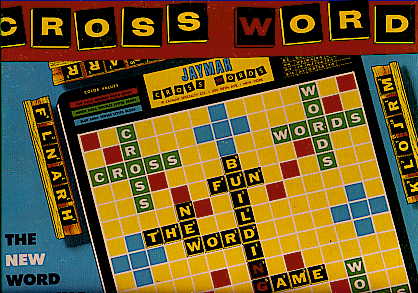
  98. Cross Word published by Jaymar, 1953
    Contains directions,
    board, 119 tiles, 2 joker tiles, 4 wooden racks, score pad and 4 letter distribution cards. Another approximate Scrabble rip-off.
  99. Cross Words National Games Inc, West Springfield, Mass
    Game #5010. Scrabble lookalike, but sufficiently different board layout to avoid a lawsuit. There is no copyright and no date on the box. Rules are printed inside the box lid. Very similar to
    Skip-a-cross in quality - cardboard board, cardboard tiles. The letters have no point values. Letter frequencies: A 9 B 3 C 3 D 5 E 12 F 4 G 2 H 4 I 9 J 2 K 2 L 4 M 4 N 7 O 9 P 2 Q 1 R 7 S 6 T 8 U 6 V 1 W 1 X 1 Y 3 Z 1 Blanks 4 (Total 120). Mild deviation from Scrabble: instead of playing on the center square to start, you must place three tiles over the center square and its adjoining neighbors. Scoring: 1) 5 points for each letter played, 10 points on own color square [Each player chooses one of the four colors before playing (red, green, blue and yellow)], 5 times dice throw on any cross square, 10 times dice throw on cross square of own color. 2) Any word over 5 letters gives player 50 points bonus (i.e. he must place in one turn at least 5 letters) 3) Letters left in rack at end of game count 5 points against score. 4) Challenges count 25 points for or against according to findings in dictionary. [GT]
  100. Crozzle published by Cadaco.
    Paper in special holders (4) form crossword frames. Letters are drawn one at a time, and all players fill their own in at the same time, one letter at a time. Try to have the most words when the puzzle is full. Incl. 4 pencils and score sheets. Instructions on underside of box.
  101. Crypt-O Manufactured for Development Products Corporation-West Orange, NJ by Newark Paper Box Co.. 1955
    Crypto hidden word board game. Included in this game is the board, 52 letter cards and 7 clue cards.
  102. Cue by Lowell Toy Mfg Corp, approx 1950.
    Solving the code is your 'CUE' to excitement and challenge in this stimulating word game! CUE is a fascinating game for 2,3, or 4 players based on the solving of secret codes or cryptograms. Includes: 10 master code cards, a large plastic "Master Code Breaker," 5 Special dice, a dice cup, blank pad of paper, instructions, and a code book containing 200 phrases in secret code and their solutions. [From an eBay ad]
  103. Cue Me! Manufactured by The Games Gang, Author Frank Thibault.
    The game contains a six-sided die, with the numbers 1-4 occupying four of the sides and an asterisk (*) on the other two sides. Upon rolling the die, the clue-giver correlates the number on the die to the number on the game card. There are five words on each card. If you roll a 1, the word will be a person. If you roll a 2, the word will be a place. If you roll a 3, the word will be a thing. If you roll a 4, the word will be an event. If you roll an asterisk, you can choose to try the asterisk word (generally much harder but worth more points) or you can choose to do any of the words, one through four. Once the word is decided, you are free to tell your partner or team how many words it is and whether the answer is a proper noun. The clue-giver then rolls four 12-sided dice, which have a letter on each side (except one side on two of the dice, which contain an asterisk for a wildcard letter). The object now is to get your team or partner to say the word on the card using clue words that begin only with the letters you rolled. And you can use each letter only once. For instance, if the word is apple, and you roll A, T, F, and W, you can say, "Fruit William Tell Arrowed." Then you must be silent and allow your team to guess. No other clues or pantamime is allowed. The clue-giver can re-roll the dice twice more, giving new clues with new letters. If the next roll is D, J, R, and P, the clue-giver could say "Johnny planted red delicious." But the clue giver doesn't need to use all of the letters. Once the team guesses, the clue-giver MUST ROLL AGAIN. Only one guess per roll, or three guesses total. The team gets two minutes. It is a very challenging game that tests your vocabulary and diction skills.

    I believe the following is the point scale:
    8 points for a "one-on-one" (one-word clue, correct answer).
    4 points for getting it on the first turn (with more than one word as a = clue)
    3 points on the second turn
    2 points on the third
    2 bonus points if it was the asterisk word
    I'm not sure how many spaces are on the board, but it's a very simple layout. The first one around wins. There are also squares where both (or all) teams get to guess at the clue-giver's clues, but we have never played with them, so I'm not really sure how they work. Anyway, it's a great game, and VERY addictive. It just so happens that, as far as I'm concerned, my brother owns the only copy known to man. I NEED a copy of the game. [JT] (I'll pass any offers on to Jim who contributed this review! - GT. By the way this doesn't strictly match our criteria for inclusion, but then there are a few others such as "Chain Letters" that are borderline as well. It was such a good review I thought I'd include it anyway)

  104. Decrypto by Armand Jammot
    (Armand Jammot is the originator of
    "Countdown")
    in this French game you uncover your opponents letters by a complex process of triangulation (on a hex grid). See also the French game Bataille de Mots Croises and the English game Decypher.
  105. Decypher by Pressman, 1982
    "The word game where your logic and deduction lead to your opponent's destruction! For word game lovers and strategists alike! Combine the skills of deduction and logic to outwit your opponent and win!" Two players, ages 8+. Two sets of letter tiles and a board that consists of four 5x5 grids separated by a screen (two grids per player). You apparently fill your grid (like a crossword?) and try to deduce the contents of your opponent's grid. Sounds like a cross between Scrabble and Battleship. [DUT]
    See the French games
    Bataille de Mots Croises and Decrypto.
  106. Diabolo from Klee
    See
    Funagain Games
  107. Dial'n Spell by Milton Bradley Company
    May be more of a children's education toy than a game.
  108. Diamino made in France
    This is a box of 63 small wood tiles that have the letters of the alphabet on them and a small number up in the corner. I have no idea how this is played, but looks like some sort of scrabble or word game/domino mix. Box says Diamino, Marque & Modele Deposes-Brevete. SGDG France & Etranger. Made in France. Box is 7" long, 3 1/4" wide and about 1" tall.
    [From an ebay advertisement]
  109. Diamino Chinois made in France
    "Chinese Diamino". An attempt to make a crossword game on a hex grid. Has 12 wild-cards to make it easier. Read about it at
    web.avo.fr.
  110. Diamino Duo made in France
    As the editor of
    this review says, "What a lack of imagination!". Has a few small rules that make it different enough from Scrabble to avoid a lawsuit, but why bother?
  111. Dictionary Please by Eric G Clarke, 1954
    Made in Portland, Oregon. 180 letters, bag, dictionary. 4 tile racks, score pads, note pads, rules. Find highest scoring word from a draw of 10 letters.
  112. Dig by Parker Bros, 1959
    Players use wands with a gummy end to dig out words from a pile of letters. Money and cards feature the Monopoly Man. Gummy wands liable to dry up with age. [AS] [GT]
  113. Dig-It published by Cadaco.
    378 letter tiles, many cards with a subject printed on each. Deal out subject cards, players simply dig into the common pile of letter tiles, spelling words relating to their subject. [SOS]
  114. Dirty Words
    Variation on Scrabble Word Cubes. 23 word cube dice, timer and instructions.
  115. Dixit published by Waddingtons.
    No information at present.
  116. Dizzy Spell published by Gabriel, 1978.
    The board is 5x5 with holes which are initially covered with reversible O/X pieces, all on the O side. Then a card with letters which align with the holes is inserted in the base. The first player uncovers two letters, making sure his opponent sees them too, then replaces the plugs, X side up. Play continues with the players alternating. After the third pair of letters has been revealed, each player may guess a word every turn. To do so, announce the word, then expose the letters (from the Xs) in the correct order. If correct, the player keeps the pieces removed and those letters can no longer be used. If incorrect, remove 2 points from the guesser's score. Once all letters are X side up, continue the process but flip the pieces back to the O side. Play continues until all the pieces are back to the O side or both players decide to give up. Score 1 point per piece. Reviewed in Games Magazine in the Jul/Aug 1980 issue. [DUT]
  117. Double Dare from Milton Bradley, ca 1900
    "Game of Words and Sentences". 295 (?) letter squares (brown backs), instructions for 4 games. [
    image]
  118. Double Eagle Anagrams from McLoughlin Bros, Ney York, NY, ca 1890.
    326 (?) letter squares. Rules for 10 games. There is a similar set called the "Golden Eagle" edition, with fewer letters.
  119. Double Talk from Continental G.I.
    Race to form two four-letter words. Reviewed by Games Magazine in Feb 1985. [JB]
  120. Double Quick by Winning Moves, 1999
    See
    Funagain Games. Also available from etoys.
  121. Duoword
    Duoword is a progressive new word game, produced in Australia, that combines attacking strategies with creative word building skill. With 14 letters to play 2 words each turn, the word potential is enormous! Score by counting the number of letters in the words played and apply the bonuses/penalties that are covered. Extra Word Bonuses entitle the Player to refill to 14 letters and play an Extra Word during that turn. It is not uncommon for Players to use 14 letters or more during a turn. Making words has never been easier. Educational entertainment for the whole family. Played on a unique circular board with 112 MAGNETIC letters, suitable for 1-4 Players aged 10-100+
    DUOWORD(R) is also a fascinating solo puzzle. A quality Australian product.
    Web site
    http://www.ozemail.com.au/~duoword [RF] (You can tell this blurb was written by the author, right?)
  122. Educational Game of Words by Crosley.
    Two Decks Per Package. The game consists of four sets of consonants (21 cards per set) and five sets of vowels (5 per set). Two to four players for one deck. For more players add another deck. For ages 5 and older. This will describe only one game that can be played: Separate the vowels from the consonants. Shuffle vowels. Deal each player 5 vowels. Place surplus vowels on table face down. Shuffle all consonants. Now deal each player 7 to 12 consonants. Place surplus consonants on table, face down. There is no need to hide cards from other players. Try to spell a word from your set of cards. Only one play for each turn. Player can draw a card from top of deck by placing a card under the deck (one exchange per play). Keep consonants and vowels in separate stacks. A player gets one point for each letter in a word. A player gets a point for each letter added to a previously spelled word. Game is over when only one player has cards but has no play. Player with most points wins the game. Example: JOY = 3 points; JOYFUL = three additional points. Crosley Products, Hampton, Florida.
  123. Escape from Elba from Cheapass Games.
    This is a board game in which the players are insane asylum inmates, trying to escape. (You each believe you are Napoleon and the asylum is Elba, where Napoleon was exiled in 1814.) In order to escape, you need to collect cards with letters on them and spell various words - you can also use them to spell weapons during the game to help you fight. [SOS]
  124. Eureka published by Amigo Spiel (Germany)
    Designed by Haim Shafir, 2-6 players aged 10+, pub April '97. A word is hidden in the mechanism, players roll dice to enable them to open flaps, revealing letters. When they guess the word they score the values of the closed flaps. [PE]
  125. Flamboozle from Pad Games
    Cross between Probe and Battleship, came with pads of game sheets. Reviewed in Games Magazine, July 1983 [JB]
  126. Flip A Word by Smethport Specialty Co, Smethport PA 16749
    Game #234. This is designed like a pinball machine, you pull back a flipper and it rolls balls into letter slots. The back opens for cardboard letters.
  127. Fluster Parker Bros 1973
    (same box size and style as the rest of the series:
    Grapple, Boggle and Razzle) "Strategy counts as players call out letters and try to make them into words. Using your special game pad, you"ll form words vertically or horizontally, using every angle to protect your words and block opponents. Score the most points fo rthe best placed words and you'l be the winner." Game pads consist of two 5 x 5 grids, each box numbered randomly from 1 - 25. Players grids are different from each other. Players take turns calling out a letter and a number (or a blank space and a number). Players then write the letter in one of the boxes with that number. Players score points for the number and length of their words. A nice quicky when you're sitting around the living room. [MS]
  128. Foil published by 3M, 1968.
    Players score points for forming one or more words from the hand of letter-cards they're dealt. They then scramble the word(s) and show it (them) to their opponents. The latter score bonus points for unscrambling the word(s) within one-minute. [DUT] Cards. Timer. Directions. [
    review]
  129. Foresight aka 4Cyte: 1967, Milton Bradley.
    "The Smart Set Word game". (Twin Set Table Model) Each player tries to score points by making 3 to 6 letter words on the game "square". The players, alternating, choose each letter as it is used. [DUT]
  130. Foresight
    Packaged version of the game which the book "The Way To Play" calls Crosswords. Players alternate calling out letters. Each playing the letters in one's own six-by-six grid. Players score for coming up with the longest possible words in the six rows, six columns and two diagonals. [AS] (This may be the same game as above
  131. Foursight
    I used to play Foursight when I was young. Players have a Battleship-like scoring grid. Each player in turn consciously chooses a letter, then each player adds that letter to his hidden grid. Evil. Plays like a word version of Take It Easy. [FB]
  132. Four Letter Words published by Lakeside, 1975.
    Using a 4x4x4 3D tic-tac-toe board, players try to make four letter words. [DUT]
  133. Gemini
    Danish card game.
  134. Glossa
    French card game that is a cross between a word game and poker. Has some chips for betting with.
  135. Go Gin by Ideal, 1968
    Maybe similar to Word Rummy?
  136. Gold Medal 7 Word Games 1940?
    Instruction booklet for Anagrams, Word Ghost, Word Squares, Word Ladders, Word Dominoes, Word Bee and Word Maze. Looks similar to one of the
    Transogram sets. Wooden letter tiles. Each tile appears to have a small number at the top center. Could this be the first time that scores were put on tiles?
  137. Goomicus Alphabet Soup Word Game by Alphabet Soup Company, 1957
    Four colored playing surfaces, a bowl, a scoop, instructions, three original score sheets and many red and green letters and "goomicus" pieces. The pieces look almost identical to the more modern German game "
    Buchstaben Suppe".
  138. Grabitz--by the company who makes UNO.
    Not a super game--players are dealt cards. These make up words that have one of the letters from "Grabitz" in them. Different point values are given for better hands. (I'll try to send a better rules update--this one has made it to the back of the closet in a hurry!) [JP]
  139. Grapple (Parker Bro 1973)
    Haven't played it, seems a lot like
    Foil. From back of box - "Players compete to outguess each other in this crazy mixed up word game. Everybody chooses his own secret word, assembles the letters and scrambles them before showing the other players. Can you find a word in the mixed up letters? You have to be quick, your opponents are looking for it too." [MS] The tiles have no scores on them. Letter distribution is: A 6 B 2 C 3 D 4 E 9 F 3 G 2 H 3 I 6 J 1 K 1 L 3 M 2 N 6 O 6 P 2 Q 1 R 7 S 6 T 7 U 3 V 2 W 2 X 1 Y 2 Z 1
    There are also 5 numbered tiles, [10], [20], [30], [40] and [50].
    At least one set also came with 5 blue plastic racks for storing letters on, a la Scrabble. (Mine had none - may be different set; or may be lost!) [GT] [Lost your copy of the rules?]
  140. Grid Word published by Waddingtons.
    Cards with two letters on them, must be played with other cards to make four-letter words. [SOS]
  141. Le Jeu de la Guerre des Mots
    See under
    Le jeu de la Guerre des Mots.
  142. Hangin' Harry
    On a recent stroll through "Toys'R'Us" I spotted a cheap plastic hanger pack version of "Hangman" called "Hangin' Harry". However when I got home I wasn't able to find it on the web anywhere, including at the
    Toys'R'Us web server. I'll watch for it next time I'm there and make a note of who the manufacturer is.
  143. Hangman published by MB.
    An old paper and pencil game revived with hardware: each player's word is kept hidden from the opponent - simultaneous classic hangman, basically. [SOS] When a player missed, a dial on the case showing a hangman was turned adding another "body part" until you were hung. The only problem is there were far too many misses allowed (something like 12). At least one version of the box is classic 70's design with Vincent Price on the cover (1976). [RI] [GT] See a modern version at
    eToys
  144. Hearts published by MB (old).
    Actually tracked this down recently in an eBay auction where it is described as a 1914 copyright from Parker Bros. May be two versions. Two throwing cannisters, 6 wooden lettered dice, rules. On the back of the box is a list of other Parker Bros games. Object is to spell the word "hearts".
  145. Intersect 90 by Family Games.
    A card game using cards with 1-4 letters on each (the more letters on the card, the more it's worth). Players form a word (word 2) using cards from their hand and one card from the previous word (word 1). The previous player scores for all cards in word 1 except the one used in word 2. [PS]
  146. I-Qubes by Capex, 1948
    Seven 5/8in bakelite dice with single letter on each side, three sides in red, three sides in black, one WILD in black and one WILD in red. Maroon leather case (4 1/2" x 7/8" x 5/8") with snap has I QUBES stamped in gold on top. Instructions copyright 1948. Manufactured by CAPEX Co., Inc. 615 South Boulevard, Evanston, Ill. Distributed Exclusively by M.WILLE, INC. 225 Fifth Avenue, New York 10, N.Y.
  147. Inword by Milton Bradley, 1972
    Trivial game of guess the missing letters. Somewhat like the US TV show "wheel of fortune". A complete game comes with original box inserts, game instructions, 5 "magic slate" work slates, 5 marking instruments for slates, a ton of words coded, a decoder, and a spinner.
  148. Jack Straws by the Electric Game Co. Inc., Holyoke, MA 1953
    A strange hybrid anagrams game that is also somewhat like 'Operation', where you remove letters from a tin can with metal tweezers that are connected electrically.
  149. Jago by Speak/Apex, Author Alex Randolph
    "Jago", combining interesting game mechanics, is a refreshing change from the large mass of crossword-puzzle-games. The game definitely shows the hand of the grand master of game design - Alex Randolph. A player may put down words on the game board until the letters of his colour are a majority on the gameboard. A cleverly constructed timer, which increases the time potential of the enemy for each minute that ticks by, prevents all too long thinking pauses. It is especially efficient to go hunting for the words of the enemy. If you manage to change their meaning by adding your own letters or by exchanging some letters against letters you own, you may change the colour of the whole word. Thus you not only decisively increase your letter-domination of the board, but in one stroke the enemy also suffers grievous losses.
    Contains board, 110 tiles, 2 letter racks, tile bag, 1 minute timer, timer board and rules. Made in Canada
    (Hans-Ulrich Schneider)
  150. Jarnac published by Chieftain in Canada, 1977
    Also published in France by a different company - here's a French review of the game which is VERY popular in France. Possibly more so than Scrabble. An outstanding and heady Anagrams game in which two players build words on individual boards but have the option to steal letters from their opponents. Superb scoring system. [MT] My favorite word game. [BF] Contains 2 non-slip JARNAC gameboards, 144 non-slip letter tiles & 1 letter tile bag and the rules.
  151. Jitters published by MB, 1986
    Jitters has 12 dice with letters and 20 cards with crossword patterns. Start the (noisy) timer, turn over a card, throw the dice, and then use some or all of the dice to form a word pattern that matches the card. If you're stumped you can reroll all the dice. When you succeed, you have the choice of stopping the timer or turning another card and rerolling. If the timer goes off by itself, you lose credit for all the cards you finished that turn. Some of the patterns are easier than others. The harder the card, the more points it's worth. Play ends when the score reaches 250. Package includes timer, cup, writing pad and instructions. Reviewed in Games Magazine in the Aug/Sep 1987 issue, and made the GAMES 100 in the next issue. [DW] [GT]
  152. Jotto published commercially in 1956/1957 by The Jotto Corporation, later Selchow & Righter.
    Basically Mastermind with letters - an excellent game, especially while waiting for your food in a crowded restaraunt - you just need two pieces of paper and two pencils.
    Here are the rules as I learned them. [MK] [SOS] Actually this game goes further back. In my youth it was called "Bulls and Cows" and you were awarded a "Bull" for a correct letter in the correct position, and a "Cow" for a correct letter but in the wrong position. Old word gamers sometimes rail against versions which give both pieces of information, as they're much easier than the variations where you are told only if the letter is correct but not if you had the position correct too. Note that traditionally you must play actual words as your test; a variation where you can play *any* letters at all is considered way too easy for word-gamers, though it is roughly how the traditional mastermind game with coloured pegs works. [GT] [image]
  153. Jotto by Endless Games (contemporary)
    These guys are on the net now. Check the
    manufacturer's page. See also Amazon.Com.
  154. Juicy Words
    Looks almost identical to "
    dirty words". May be a repackaging to help it sell better. 21 dice.
  155. Jumble by Cadaco (contemporary)
    Despite what I said in the introduction, it looks like Jumble should be included here because there is a board game version as well as the electronic one: See
    Cadaco for details - gameboard, 110 letter tiles, plastic letter tray, sand timer, 6 letter tokens, bonus sleeve, scorepad, pencil. [GT]
  156. Jumble Plus - "That Scrambled Word Game"
    And breaking my own rules again, I've decided to include "Jumble Plus" because although it is essentially a pen and paper game, this version uses letter tiles and a board for you to place your solutions on. (The problems are pre-printed sheets of anagrams that you have to solve)
  157. Kan-U-Go published by Porterprint. 1934
    Players make words from the cards in their hand, adding them to what's on the table in crossword style. If you can't go you pick up a card, first to get rid of all their cards ends the hand. Score is values of cards left in hand, which count against you. Games ends when someone reaches 100 points and player with fewest points wins. Similar type of game to
    Crossword Lexicon, and indeed they have pulled the same trick as crossword lexicon of having complimentarily-colored boxes (one box is red with a blue stripe; the other vice-versa). There are both red and blue sets of cards but there doesn't seem to be a fixed rule as to which box they go with.
    It's interesting to note that as time goes on with these games, the cards get smaller and smaller as they converge on the cardboard tile format of the old Anagrams games and eventually mutate into the small tile format we know and love from Scrabble. Kan-U-Go is practically Scrabble without the board. There are 60 cards including the two "Kan-u-go" wild-cards: Frequencies - A 4 B 2 C 2 D 3 E 4 F 2 G 2 H 3 I 3 J 1 K 2 L 2 M 2 N 2 O 3 P 2 Q 1 R 3 S 3 T 3 U 3 V W 2 X 1 Y 1 Z 1 Kan-U-Go (wild) 2; Scores - A 10 B 5 C 6 D 5 E 10 F 5 G 4 H 7 I 10 J 2 K 2 L 6 M 7 N 8 O 10 P 7 Q 2 R 5 S 10 T 6 U 3 V 2 W 7 X 2 Y 2 Z 8
    Although it was originally listed here as being published Waddingtons in 1937, my copy says "Sole Proprietors PORTERPRINT Ltd, Leeds England" and has a copyright date of 1934 at the back of the manual. [image]
    Here are the rules from a British edition. Note there is also a US edition with a rule book copyright 1937 by T.G. Porter (Printers) Ltd., Leeds. It was distributed by A.A. Burnstine Sales Organization, 200 Fifth Avenue, New York. [PE] [GT]
  158. kan zen from Landmark Games
    A small ad in the Mar/Apr 1979 issue of Games Magazine (and even smaller ads in the following three issues) called it a "word game." No review nor indication of how to play, though. That first ad said "the perfect word game -- for those who love action as well as words." [JB]
  159. Keep Quiet published by Kopptronix.
    Letter dice with the manual alphabet for the deaf on them. One game is crossword-style, another longest word. Timer and dice cup. Just like Scribbage et al but with alternative alphabet. (Makes me think there ought to be a version of Scrabble like this...)
  160. Keep Quiet Reword published by Kopptronix.
    Cards are played four or five at a time to make words, then words can be partially covered up to make new words, as in Up Words. The cards have the English alphabet on the reverse side of manual alphabet. [SOS]
  161. Keyword published by Parker Brothers, 1953.
    Crossword game similar to
    Scrabble with the added gimmick of getting bonus point if you can spell your randomly drawn word. Each letter is 5 points unless played on your color, in which case it's 10 points. There are also keyword squares, which are worth +20 points. And keyword cards, which are turned over one at a time until claimed - if you spell the keyword, claim the card which will add 50 points to your score at the end of the game. The board has four colors of squares, mostly clumped together in each of the corners. I have fond memories of this game, as it was my grandmother's favorite game, and I played many times with her while growing up. The 88 tiles (one ebay ad said 90?) are wooden, with white lettering on a black background, reminiscent of domino tiles, and actually very much like the tiles from Anagrams Embossed Edition or Anagrams Ivory Edition. Also includes four scrabble-like wooden letter holders. (Here is frequency info from an incomplete set: A-6, B-1, C-3, D-4, E-11, F-3, G-2, H-2 (should be 3?), I-7, J-1, K-1, L-3, M-2, N-6 (should be 7?), 0-6, P-2, Q-1, R-6 (should be 7?), S-5 (should be 6), T-6 (should be 8?), U-3, V-1, W-1 (should be 2?), X-1, Y-2, Z-1, with 2 extra blanks, (they have been written on). 89 pieces in all (should be 96?)) [SOS] [AS] [GT] [image] There is also a nicer maroon box version of this which looks more 'up market' and may be designed to look deliberately like the early Scrabble boxes. This edition has black lettering on white tiles - also more Scrabble-like.
    See also the French version, La Clé
    Note also an edition "manufactruedin England by John Waddington Ltd" dated 1953 also. Box has a copyright "Parker Bros, Inc., Salem Mass, USA" Contents look identical to US edition. Much nicer box art, IMHO.
  162. Knock-on-Word: Xanadu Leisure
    Prince Kansil reworks
    Montage by replacing the color tiles with letter tiles. [AS] [PJK]
  163. Kontrast published by Matthews & Marshall.
    112 cards - empty hand by spelling words. [SOS]
  164. Kort Alfapet Swedish
    Card Alfapet (Kort Alfapet)
    The card and travel version of Swedens most popular word game (Alfapet), is based on the idea of creating words out of the letters on the cards. One of the most successful card games in Sweden, the game provides hours of fun in a simple way. For 2-4 players, Age 9 and up, Playing time about 30 minutes. [Rules in pdf format]
  165. Kwip by Playbox, 1978
    A
    French word game in the style of Drafts (Checkers).
  166. La Clé 1954.
    Keyword in French. Brought out the year after the English version. Read about it at www.avo.fr.
  167. La Roue de la Fortune
    French version of "Wheel of Fortune".
  168. Last Word published by Milton-Bradley, 1985.
    A 10x10 board is loaded with tiles, randomly. Players then walk their piece across the board, picking up tiles as they go, trying not to become stranded. On your turn, you get to pick up an entire word, so this goes pretty fast. The board is treated as wrap-around (toroidal continuity), which keeps the edges from being traps. Bonus points for isolating an opponent and for being the last to pick up a word. 2-4 players.
    Contents: Board, 92 letter tiles, 4 blank tiles, 4 coloured pawns. Instructions. Reviewed in Games Magazine in Jan 1986. See
    image and description [DUT] [GT]
  169. Leapin' Letters by Parker Bros, 1969
    See
    justcollectors.com
  170. Lecardo
    A hybrid word game, playing card game, and domino game. 52 cards, 3 jokers, and 1 blank. Rules for 3 different games. May be make in UK?
  171. Le Jeu de la Guerre des Mots
    French game which is a cross between a military strategy game and a word game. tactics is more important than vocabulary.
  172. Le Mot le Plus Long
    The "Letters Game" from
    Countdown, French version. This, Scrabble, and Jarnac are the three staples of French wordgaming.
  173. Le Pendu
    French version of "Hangman".
  174. Letra Mix by Schmidt Spiele
    Described as a "scrabble-style dice game". Almost certainly another Scribbage variant. Includes 13 dice, cup, timer and instructions.
  175. Letre Deck 1978
    The side of the box says "Create your own exciting card game". Contains 50 cards with letters & 2 Wild Cards. Each card measures approx. 2.5" x 3.5"
  176. Letres
    Another Word Rummy?.
    Description here.
  177. Letter-Bags invented by Alexander Millar.
    "A Word-Making Game For Any Number of Players on an Entirely New Principle". No date, but the printing style is somewhere between 1900-1940 is my guess. The box reads "The Late Alexander Millar" so I presume this was published posthumously.
  178. Letter Grams by Milton Bradley, 1938
    Yet another of the many cross-word card games of this era. Cards have scores on the corners.
  179. Letter Perfect publisher unknown.
    84 letter tiles, 8 spelling cards, boards. This is really a children's educational spelling toy, and may not be appropriate to these pages, but although it is for 4 and up, the board and number of tiles suggest it could be adapted for play by adults too, or at least older children, with a bit of ingenuity. So I'll leave it in.
  180. Letter Pile by Schaper, 1974
    Stylized letters are printed on clear plastic cards. Players gather the letters of their secret words into stacks; opponents try to guess the words by examining the lines and curves on the pile of overlapping cards.[BB2] 4 colored plastic letter holders & base, 60 transparent letter tiles, 1 clue pad, 1 timer, box insert.
  181. Levenger Crossword Dice
    Seven dice. 4 sides have letters, remaining two sides are wild. Leather carrying case, unusual game box.
    From the
    Levenger web site:
    The object of Crossword Dice is to obtain the highest score in an allotted amount of time. Each player throws all seven dice and tries to create words, horizontally and vertically. The game can be played by groups or as solitaire. It's fun to play for short periods of time, or it can be a long-running game between partners. You can play it almost anywhere without requiring the space and time commitment of Scrabble® or crossword puzzles. It's good for teaching children, too. The buttery yellow dice are packed in a eather case, which makes it great for traveling. The game comes with easy-to-understand rules and is small enough to keep in a pocket or purse. We recommend you buy more than one because you may want to enjoy giving a few away. The leather case measures 4 5/8” by ¾” by ¾”. The Dice are 5/8” square. Gift boxed.
  182. Lexicon published by Waddingtons.
    First published in 1933, this game uses cards, crossword fashion. Cards left in hand when someone goes out count against you - low score wins. Combine two sets to play with up to eight. [SOS]
    Actually I have this one somewhere although I can't find it at the moment. What I do remember though doesn't agree with Steffan's recollection: I'm sure it was played as a one-dimensional game, not a crossword game. It may have been both, with different sets of rules being published at different times? The most recent package I've seen is dated 1968. See also
    Crossword Lexicon [GT]

    UPDATE: Finally... my memory was not wrong. The Lexicon I remember playing in Britain was not a crossword game, but was indeed played in a straight line, somewhat like paper and pencil games such as Ghost. Here are the rules to the French edition, which are very close to what I remember of my British edition bought somewhere around 1980. [Confirmation here!]

  183. Lexicon with tiles published by Waddingtons.
    A variation on the card game above. Four players round a square tile rack - not so much a board, just a common place to lay your tiles while working on them. 1970's.
  184. Lewis Carroll's Chess Wordgame published by Kadon.
    Played on a chess board, each player starts with a letter in each of his first rank squares. You try to spell words on your fifth rank, moving letters one at a time as if they were queens. You may not stop on your fourth or eighth rank, but may move to your sixth or seventh, in an attempt to block your opponent. Despite the name, it's actually by Martin Gardner, based on a brief mention of the idea in one of Lewis Carroll's notebooks. It's okay - neither great nor bad. [SOS]
  185. Lingo published by Lingo Games.
    Words are built on a 5x5 grid, any direction, even diagonally. [SOS]
  186. Lingo published by All-Fair (EE Fairchild Corporation, Rochester 2, New York, USA).
    This is a blatant Scrabble rip-off - or more likely, a rip-off of the licensed Scrabble clone
    Skip-a-cross, because the production values, coloring, contents etc are almost identical. The board has the word "lingo" written one-letter per square in various places, and you score extra points for playing the letters of "Lingo" on their own squares. Also extra points for playing words conforming to a fixed list of themes: animal, mineral, vegetable, fruit, tree, bird, insect, clothing. Similarities to Scrabble: double score for first word. Two wild-card tiles with a "Joker" image on them. Tiles have a score in the corner - the upper right corner that is. Red squares: double letter value, Yellow squares: triple letter value; Blue squares: double word total; Purple squares: triple word total.
    The set also contains two blank tiles that can be used in case any letter tiles are missing. The tile distribution is: A 10 B 2 C 3 D 3 E 13 F 3 G 3 H 4 I 10 J 1 K 1 L 4 M 3 N 6 O 9 P 2 Q 1 R 6 S 5 T 6 U 4 V 2 W 2 X 1 Y 2 Z 1 Joker 2. The points values are: A 1 B 4 C 2 D 2 E 1 F 4 G 4 H 2 I 1 J 8 K 8 L 2 M 2 N 1 O 1 P 4 Q 9 R 1 S 1 T 1 U 2 V 4 W 4 X 9 Y 4 Z 10 Joker 0
  187. Lingo published by Centaphrase
    The
    AGCA site also has a reference to another game called "Lingo" which may or may not be either of the ones above. However they attribute this one to "Centaphrase".
  188. Lingua
    German game, manuf. unknown. Crossword word game in the Scrabble vein, board has more colored squares than Scrabble; cardboard? letter tiles (circular, for a change) are also colored. I presume that as in "wordy" there must be bonus scores for matching the tile colors to the board colors?
  189. LinguiSHTIK by Robert W Allen, National Academic Games 1973
    An academic game for school children, not generally sold to the public. (There's an
    interesting side-story to this game involving a lawsuit you might want to read.) The game has 23 differently-coloured letter dice. I believe part of the game is to make the rules up as you go along! The rules are more like meta-rules. [GT]
  190. Litterax 1994
    French game which is a cross between a word game and battleship. (What, another one???) 7x7 grid. When your opponent guesses a letter, you have to tell him all the positions (eg A3, D5 etc) where that letter is on your grid.
  191. Logomachy, or War of Words published by F.A. Wright Co., 1874.
    Mentioned in Sid Sackson's book, A Gamut of Games. [SOS] [
    image]
  192. Logus Sr from Ideal, 1971
    billed on the box as "the slide-letter word game." For two players or teams. The Logus boards are constructed like those sliding puzzles where you have to slide the squares around to make a picture or put the numbers in the right order and you have only one empty space to work with. The boards in Logus Sr. have four rows and five columns containing 18 letter tiles and two empty spaces in the grid. F, J, K, P, Q, V, W, X, Y, Z are omitted, while E and O get two tiles apiece. You draw a card specifying the goal for each round. It could be anything from "make a 3-letter word beginning with B in column three" to something similar specifying three or four intersecting words. Some even call for words fitting a certain theme, such as baseball terms or boys' names. The more difficult cards are worth more. Players race to slide their letters around and whichever one fulfills the card first wins it. After you've played however many cards you agreed to, high score wins. One of the cards has an ad for Logus Jr., a children's version of the game.
  193. Maestria, by Productions Mava, Montreal (Qc), 1991
    Copyright Martinez-Vachon 1991
    102 square tiles representing blanks, straights, knees and tees. Two boards, rules, bag for the tiles, scorepad. The two players (or teams) draw some 40 tiles at random each and try to assemble them so as to spell a 5+ letter word. Letters are three tiles high and between one and three tiles wide. Once a player is satisfied, the other has a limited time in which to complete his word. Scoring is based on the overall word width.
    > >    Maestria, by Productions Mava, Montreal (Qc), 1991
    > >    Copyright Martinez-Vachon 1991
    > > 102 square tiles representing blanks, straights, knees and tees.
    > =
    
    > You mean letter components, as in Runes?  Interesting - how do you do Q
    > or C?
    
    I cannot give you a definitive answer as I only saw that one on the shelf and jotted down its description. You'd make a C out of three straights, four bends and two blanks (an O with the right-hand straight replaced by a blank); a Q probably would be an O with the lower right-hand bend replaced by a tee. [DUT] Was in the "Games 100" several years ago. [CS]
  194. Magnetic Phonetics published by Cascadilla Press
    See
    their web page. Includes a version of their IPA font refrigerator magnets with scores on the tiles meant to allow you to use them in a Scrabble-like game. [People interested in such things may also be interested in Playing Scrabble in Lojban]
  195. Maxim Emmor Ray Sperry
    Charityware? (Not in production.)
    See his web page. The web page says you need explicit written permission to copy these games, but the intro page says: Any individual or group that would like to make and play these games for their own use has permission to do so, "FREE". Manufacturing, for sale or rent of these games, in whole or in part by any means, without written permission from the "Superlative Game Co. Ltd." is strictly prohibited.
  196. Mensa IQ Word and Number Puzzle Pack published by Mensa, 1999
    72 page book, 100 cards, game board, dice, counters, several games including 9 word games.
  197. Miramis by Laurent Montels, 1986
    A
    French crossword game with the tweak of colored squares and colored tiles. Sounds like "wordy".
  198. Montage published by Gamut of Games
    Designed by Prince Joli Kansil. You form a word on a board with chips, each color of which signifies several different letters, and give a clue to it; your partner tries to guess it before either opponent can. Whichever side gets it owns those chips. See the review in
    The Game Report[TU]
  199. Mots de Tête by Habourdin International
    A
    French game where a free choice of words is played on a board cross-word style. Unlike Scrabble, the game is in the placement, not in the finding of words.
  200. Motus 1993
    Version of a French TV Game which looks a lot like Word Mastermind.
  201. Mudiwoga from Mudiwoga Distributors
    Name is acronym for multi-dimensional word game. Build a crossword puzzle, tiles have multiple letters so a tile doesn't have to represent the same letter in the across word as in the down word. Reviewed in Jan/Feb 1982 issue of Games Magazine.
  202. My Word published by Gamut of Games
    a.k.a "Zig Zag" by Prince Joli Kansil. Similar to
    Jotto. [MK][PJK] Made the Games Magazine's GAMES 100 in Nov 1985 and Nov 1986.
  203. My Word by Waddingtons
    is a word-forming game very like a simplified
    Scrabble with no board - but all the words are of four letters. This not only makes it less of a strain on the brain, but also, of course, opens up the opportunity for unofficial extra points-scoring rules for adults in a juvenile mood. Keep it clean, and it is suitable for children down to eight or less. It is for 1-6 players, and works well for any of these numbers of participants. And I like it. [DUT]
    (Source: http://www.spiritgames.co.uk/reviews.html)
  204. The Next Word from Decipher Inc.
    This is (I think) EXACTLY the same game as Pressman's
    Overturn. Decipher just had an earlier version under a different name. Listed in the GAMES 100 in the Oct/Nov 1987 issue of Games Magazine. Also was reviewed in the Summer 1987 issue of Gamers Alliance Report. [JB]
  205. Nexus published by Lodestone Games.
    Six variations of
    Anagram style games for one to four players. 100 tiles; some have letters, others syllables, the latter scoring more points. [SOS] [AS]
  206. Oh Scrud!
    Read this review, with image. 108 cards, fast paced simultaneous play. Buy it here.
  207. On Line by the Michael Kohner Corp (Swedish)
    Look for Online under word games at the left in this link
    Trivia game where each answer must share a letter with the next. May not really be appropriate for this page, but I thought we could do with more non-English listings... Similar to Chain Letters
  208. ON-WORDS from Wiff'n Proof Publishers, 1971
    The Game of Word Structures - objective is to spell words or networks of words while preventing others from spelling theirs. [DR] Designed by Layman Allen, according to a Nov/Dec 1979 article in Games Magazine on the National Puzzlers' League convention. Article also describes a solitaire version called Word-Making that was presented at that convention. Apparently Word-Making was not published commercially, as it could be played using only pencil and paper. [JB]
  209. Option published by Parker Brothers, 1983.
    A crossword game using prisms. Play includes flipping prisms already on the board to switch them to the alternate letter. Players score extra if the word is all in one color. Why they didn't use all three sides of the prisms is a mystery. [DUT]
  210. Ord på ord
    Word on word (Ord på Ord)
    A very simple crossword-type family game, where you play head to head by randomly selecting letter tiles and try to create as long words as possible. The longer the word, the more points you score. When all 49 letters have been used up, the player with most points win. For 2 or more players, Age 9 and up, Playing time about 20-40 minutes. [Full-page ad in pdf format, 761K]
  211. A new and Amusing Social Game of Orthographical Representations published by William MacGill, 1870
    This is an early Anagrams game. From an ebay posting: A mahogany box containing many letters of the alphabet (over 400?). They are made of a kind of cardboard, printed and glazed. Called "A New and Amusing SOCIAL GAME of ORTHOGRAPHICAL RECREATIONS." C.1870. Size of box 12 x 7 x 1 7/8 inches.
    This is an extremely attractive case set and looks like a real collectors piece. The tiles are not just letters but include ligatures and other characters, much like a printers type case. The ebay reserve on this was 50 pounds sterling. I can just make out on the photo of the label: William MacGill, Artist-Colourman, Printseller and Stationer, 105 Princes Street, Edinburgh. Always on hand - a surfeit of Artists' Material of the Best Quality. Drawings Lent to Copy.
  212. Overturn published by Pressman.
    The letters are printed right on the board in this game. The board for a single game is made up of 9 small squares, each with four letters on them. There are 18 squares included - rotate and shuffle them after each play, and you'll get a different setup each time. There are circles (green on one side, silver on the other) which fit over the letters. Spell a word as in
    Boggle and claim those letters by placing circles around them, your color up. The next player must use at least one new letter and one used letter, flipping any circles around letters used to his color. Very good game. I have an article on three-player Overturn. [SOS] See also Next Word from Decipher Inc. This is also available in French, except that it is sold by Mattel! I tell you, I have trouble keeping track of all these companies.
  213. Pago Pago published by Just Games
    Players race to fill in crossword puzzles, using different colors of pencils so as to tell who filled in which squares. Review in July 1986 issue, made the GAMES 100 in Nov 1986 issue. [JB] (not a perfect match for the letter-by-letter games page, but we'll include it anyway)
  214. Palabra published by Kondrick, 1990
    Seven-card hands. Two or three stars on some cards serve as multipliers so you can score 2*2*3*3*3 times the base score if lucky and careful. Player interaction is minor. Requires some defensive strategy. There is a detailed review in the
    Game Report Online This positive review points out several kinds of defensive plays one can make. [TU] [BS]
  215. Pass the Bomb published by Gibsons Games, 1996
    (box text: "Invented by Los Rodriguez and licenced by Weekend Games; Made in Austria by Piatnik, 1994"). Like Hot Potato, you don't want to be the one holding the bomb when it explodes. In order to pass it to the next person, however, you must first say a valid word containing a given sequence of letters (or, since bluffing is encouraged, make people _think_ you did...). [BB2]
  216. Patch Word manufactured by Fairchild Corp., Rochester NY
    Crossword card game with small cards. No details yet. Dated somewhere between 30's and 50's perhaps? [GT]
  217. Peeko 1964
    "192 word games for the whole family". "Open the window and find the word"
  218. Le Pendu
    See under
    Le Pendu.
  219. Perfect 10 published by Smethport.
    Yet another variant of
    Anagrams, but with only 100 tiles. [SOS]
  220. Perquackey published by Hollingsworth Bros, a product of Cardinal Industries, Lakeside Industries, MINN, 1956
    (I haven't confirmed other reports that either "Shreve Co." or "Pressman Toys" had their name on a Perquackey box yet, but with the across the board aquisitions and megers of toy companies in latter years it may well be true - GT)
    Old version is red box with PQ cubes showing and hourglass. (This one has a rules leaflet dated 1956, copyright The Shreve Company). 1970 version (Game #8313 is white box with photo of spilled cup on front). 13 cubes; 10 black; three red. Players roll 10 dice, then rattle off all 3+ letter words. You can only get points for the first 5 words with the same # of letters (5 3 letter words, 5 4 letter words). Point scoring is based on number of words of each type. Once you are vulnerable, you add a few red dice (with more obscure letters) and must start with 4 letter words. One becomes vulnerable after reaching a certain score. When vulnerable, if you do not score at least 500 points, then you gain NO points for that turn, AND in fact you SUBTRACT 500 points from your previous score. Solitairish (take turns, race point score). One of many similar dice game. Unlike
    Scribbage, Ad Lib and others of that style, you do not have to form crosswords in Perquackey. [BB] [GM]
    See the Games Cabinet for rules. [GT] [image] [1970 version image] [1982 version image]
  221. Phlounder published by 3M (Minnesota Mining and Manufacturing Co), 1962.
    Letters are fed randomly through chute-like troughs; players try to make words out of what comes out. [DUT] Here's a good external link to
    The Gamepile.
    Contents include board, 90 wooden letter tiles, metal bell, 3 special dice, score pad and instruction folder.
  222. Pick Two published by Tah Dah, 1993
    Form words with cards as quickly as possible. When you form one the other players have to take two more cards and continue. [RI] [
    Description here] [Review] Games Magazine Best New Word Game of 1993.
  223. PiQadilly, by Chatham Hill Games
    Score your Wordplay with a grand PiQadilly and Riffle along the Ruffle! The Queen awaits! Welcome to the fabulous world of PiQadilly, the "Alice in Wonderland" of word games! Created in the fanciful spirit of Victorian whimsy, PiQadilly is both a thoughtful challenging crossword style word game and a wild, rousing board game that will have you "Riffling along the Ruffle" You are in a race to be the first to dine with the Queen, waiting majestically in the center of PiQadilly Circus. Through skillful WORDPLAY, you move around the colorful game board, "Riffling" along the "Ruffle". Move ahead while sending your opponents back with the right plays, and dont forget about the Q! Once youre moving along the Ruffle, the game gets "curiouser and curiouser" (as Alice would say). Your playing piece changes size during the game, if you plan your WORDPLAY carefully, youll be in control but its not always easy. BIG and LITTLE usually dont get along, so be careful you dont get BUMPED! The colorful alphabet spaces let you make BONUS plays that can speed you on your way. Once you completed your way around the Ruffle, you're ready to enter PiQadilly Circus, but only LITTLE can squeeze through the EXIT. If your BIG well, youll just have to wait a trun to shrink! Once your in PiQadilly Circus, its a wild race to enter the Palace and win the game. But remember if you or anyone can spell "QUEEN" at anytime during WORDPLAY, the game is over, and you win!
  224. Play On Words, by Copp-Clark, 1971 (under licence from E. S. Lowe)
    Equipment consists of a
    Scrabble-like 9x9 board (with some double and triple word score squares), 20 dice whose faces have letters and points, and a timer. Apparently, one rolls the dice and then has a time limit within which to decide on the word to play on the board. [DUT]
  225. Play On Wordz published by Milton Bradley, 1986.
    It has a plastic case with 9 dice (called a dice roller), and custom scoring sheets. There are 6 dice in an outer circle and 3 dice in the middle. Each die is in a cavity and can't be removed. A player rubs his hand over the dice, rotating them, and places the game on the table for everyone to see. The object is to use the letters shown to make words of 4 or more letters. Letters do not have to be adjacent. First player to make 10 words says STOP and players compare lists. Duplicate words are eliminated. Each remaining word counts one point. Words with more than 4 letters get an extra point for each letter over 4. We like it a lot, and adjust the rules for younger players or poor spellers as needed. [CK] Includes score pads. See also
    Stellar Speller
  226. Travel Play On Wordz published by Milton Bradley, 1986
    See
    above. Identical. Actually there may not even be a non-travel version...[GT]
  227. Plug-a-jug by Parker Bros
    Their gimmick is 32 letters in a jug instead of the usual dice cup or bag.
  228. Pokari by Warren Paper Prod. Co. Inc, 1979
    Also copyright 1979 by Creative Learning Assoc. "Play Poker with words". 25 games listed in the rule book, two decks of cards (70), and dice. From an
    eBay seller
  229. Pounce
    No details at present [DUT]
  230. Drew Pearson's Predict-a-Word 1949
    I'm afraid I let the eBay page with this on expire before I got around to adding it, so the images are gone and I've no idea what kind of game this was.
  231. Prefix
    Find all words that begin with a given prefix.
  232. Probe published by PB, 1964
    Game #200. Word guessing game like a sort of simultaneous Hangman. [RI] [DUT] [Rules at the
    Games Cabinet] [1964 image] Here is info on Probe in French.
  233. Pronto published by Selchow and Righter in the late 1970's (1978 seen).
    A letter dice game, where you receive credit for various combinations. Similar to
    word yahtzee but with different scoring possibilities. Excellent solitaire. Rule book. Score pads. Reviewed in Games Magazine in July 1984 [MT] [GT]
  234. Protiles
    See the website. Unofficial tiles for Scrabble playing. See also Transparent Tiles.
  235. Punch Line from Parker Pros
    It had horizontal strips of letters that slid back and forth in a rack so you tried to spell a word vertically that would complete the sentence that had been drawn from the deck. Reviewed in Games Magazine, May/Jun 1979. [JB]
  236. Puzzle Struggle from Innotoy Inc.
    "The Challenging Crossword Game." No review, so unsure if this is truly letter-by-letter or not, but ads sound like it probably is. Ads in Oct, Nov and Dec 1986. Ad says, "Puzzle Struggle is the exciting new word game to play with your family and friends. TIRED OF WAITING for others to finish a turn? The unique challenge feature allows all players or teams to participate in every turn. There are 20 complete, reusable games in this big, 169 piece, top quality game set." [JB]
  237. Pyramid Crossword Cubes from Crisloid, 1969
    Comes with plastic playing board, timer, dice cup, instructions, and 15 letter dice. Looks like cross between scribbage and boggle, with dice being emptied into a triangular shape rather than a square.
  238. Quadtriple published by Eltron.
    No information at present. Once had a link to http://baymoo.sfsu.edu:4242/3333 Advertised in Games Magazine in May/June 1979. [DUT]
  239. Qubila by NBC TV, 1955
    "Steve Allen's Quibila". 7 dice?, shaker, scorepad, instructions.
  240. Quble by Geospace (contemporary)
    Rubik's Cube but with letters on the faces as well as colours. Looks like you make words boggle-style as well as solving the cube. See
    Amazon.Com
    Includes egg-timer. Sold in bubble-pack.
  241. Que published by Knots.
    Cards with letters - some have one letter, others two-letters, and there are two wild-cards. Many variants given. [SOS]
  242. Quibbix published by Intelli, Author Gilbert Obermair
    From the
    Spiele Des Yahres site:
    You take 10 tokens (each showing a letter) from a pile of 120 letter tokens (printed side downwards) and try to use them all in forming words with a time limit of 5 minutes. You receive points for the used letters -- depending on the difficulty of the letters 1 to 3 -- and note these points on a notepad. All points of the letters in the longest word count twice. Then you take five more tokens and combine them with the old ones to form new words. In the third round you increase your stock of letters by five more tokens (20 altogether) and try to make as long words as possible again. Finally you add up the points of all three rounds to find the winner. This simple rules were written by Gilbert Obermaier, who left our jury at the same time he created one of the wittiest word puzzle games of late. (Uwe Petersen)
  243. Quibble published by Just Games.
    Ten wooden sticks have 10 letters on each edge. Randomly place them to make a 10x10 square of letters. Some variants require finding words in a given row, others in the whole array. [SOS]
  244. Quick Spell
    Battery-operated gadget which I think just shuffles dice, which you then find words in. Requires also pencil and paper (not supplied).
  245. Quickword, by US Game Systems (or Aristoplay?)
    "The Ultimate Word Game": This is a wonderful word game for travelling. It calls on a number of different word skills: listing subjects in categories, listing subjects in categories according to first letter of name of person or object, listing words according to a beginning and middle letters, etc. Wonderful for someone in a boat or RV or tent or travelling with a suitcase. It measures only about 4 x 7 inches, about 1 1/8 inch deep. Can be played as solitaire as well, but not as much fun... Comes in a blue case the size noted above. Included is instruction sheet, a pair of mini dice, Blue, Pink, gray and aqua cards, score sheets, scratch pads. egg timer, board with a built in spinner. See it at what may be the
    manufacturer's site. [not 100% match for inclusion in this web page. May remove later]
  246. Quiddler, by SET Enterprises Inc
    It's a deck of letters similar to Word Madness, with better rules. You are dealt a varying number of cards each round, similar to the card game "Oh Hell", and have to either make all the letters in your hand into one or more words or discard and draw. There's a bonus for lots of short words, and a different bonus for longer words, plus the letters all have point values which count towards your score - or subtract, if you're holding them and they can't be used in a word when someone else goes out. [SOS] See it at
    Amazon.Com
    More info from the manufacturer's site.
    Review
  247. Quizzle published by Copp Clark Games, Canada, 1978.
    There are four plastic crossword grids, a supply of cardboard letter tiles (also wild blanks and black squares) and a special die marked (1 1 2 2 3 *). On a player's turn, he rolls the die and places that many letters of his choice on the grid (other players simultaneously draw the same tiles but place them on their own grids as they choose). A Joker (*) counts for either 3 tiles or the replacement of an already-played tile. The game ends once the grid is filled. Only completed words count for score. [DUT]
  248. Qwink published by Selchow & Righter, 1985
    "Quick as a wink" word game. 100 word tiles, foldable partition (battleship style), and word-tile case.
  249. Rätsel Turm, a game by Heinz Meister, published by FX Schmid, 1992.
    The aim of the game is to build towers with coloured blocks, the lowest block representing the first letter of a word, etc. There are blocks of different colours: green means A, B or C; yellow D, E or F, etc. Five different games use this basic system. For example, each player on his turn builds a tower, and the first other player who finds a corresponding word scores 1 point. Another example: The first player chooses a block, and each player on his turn must add a block on the top of the tower, or accuse the former player of bluffing when he cannot name a corresponding word. [BF]
  250. Razzle published by Parker Bros, 1981
    Try to move a carriage towards your opponent. The carriage has six letter dice which rotate when the carriage is moved. First to find a word formed with the letters showing moves the carriage towards his opponent, which then rotates the dice to reveal different letters. [SOS]
  251. Red Letter published by Games Gang.
    Like
    Scrabble - not entirely accidentally one suspects - except all letters are worth 1 pt. Letters can be either upper or lower case allowing proper nouns. Bonuses for using all red letters (especially in the red zone -- outmost 5 rows/columns of the board) and bonuses for using words that fit a category listed on a card and with so many letters. Probably a game designed more to outwit patent lawyers than anyone else. [RI] [GT]
  252. Red Seven
    A
    French game which is a poor hybrid of Bridge and Scrabble.
  253. Reflective Word Game by Marcel Mayes
    Unpublished game
    looking for a manufacturer.
  254. Republican Word Game 1984
    These were handed out at the 1984 Republican National convention.
  255. Rock and Roll by DEWL Plasti-Toy Corp, 1957
    200 5th Ave, Ney York 10 NY. 8 plastic dice with letters and scores, some faces have a musical note on them. Faces are red and black (on same die). A variant of Scribbage-like games with a punning musical theme. Company slogan is "Make it a rule - Buy DEWL!"
  256. Rol-It
    "A fast crossword game" "Educational * Fun * Exciting". Grey box, name in red. 11 or 12 dice, maybe more, shaker. Looks like the many crossword dice games of the thirties to fifties.
  257. Roll-A-Word
    7 letter dice (I think), cheap plastic cup. Simple game to find longest word from throw. Originally sold at 39c. 1950's?
  258. Roll-A-Word freebie with Post Cereal
    8 letter dice, cheap plastic cup and rule sheet. Simple game to find longest word from throw. Sent off for from a Post Cereal box. Shipped in a brown cardboard box. No fancy packaging.
  259. Roll-A-Word
    A different version - looks much older - with 12 wooden dice and a cardboard cylinder cup with lid. Spotted on eBay. Single-sheet foldout rule leaflet definitely says "ROLL-A-WORD" at the top.
  260. Roll-A-Word
    The dice in this one look like the dice in the first Roll-A-Word above; this variation is packaged in a transparent plastic ball and may have been sold in a gumball machine. The cubes are all marked "W Germany". The container is embossed with "registered 2 V". Just a guess, but this may be from
    Keiler Corp?
  261. Rondo published by Ravensburger/FX Schmidt (Germany), designed by Abrahami/Netz
    2-4 players aged 12+, pub 97. Stand holds letter cards and can be extended as the length of the word increases. Players make words by adding, changing or blanking out a letter in the word that's already there. [PE] Played in the
    Netherlands and in Spain. There may be an on-line version here sometime.
  262. Rootie Kazootie from Ed-U-Cards
    30 cards? At least pre-1973. No more info.
  263. Roots from Heritage Products Ltd.
    An ad in the Sept/Oct 1978 issue of Games Magazine said: "...the excitement of poker ... the suspense of gin rummy ...the smartness of scrabble. America's new family word game. ROOTS. ROOTS is a head-to- head competition, your brains against everyone else in the game. There's suspense right up until the last card is played. And your family name, your 'roots', can help you be a winner." [JB]
  264. La Roue de la Fortune
    See under "
    La Roue de la Fortune"
  265. Royalty published by US Games, 1959
    Similar to
    Word Rummy except you only score if no one can steal your word in one round. [RI] Copyright dates on the rule book I have here are 1959, 1961, 1964. It's in a nicely presented little clasp pack. Game has two sets of 53 cards: one pack has RED: a 3 b 0 c 1 d 1 e 3 f 0 g 1 h 1 i 2 j 0 k 1 l 1 m 0 n 2 o 2 p 0 q 1 r 1 s 1 t 1 u 1 v 1 w 0 x 1 y 1 z 0
    BLACK: a 2 b 1 c 0 d 1 e 3 f 1 g 1 h 0 i 2 j 1 k 0 l 1 m 1 n 1 o 2 p 1 q 0 r 2 s 0 t 2 u 1 v 0 w 1 x 0 y 1 z 1
    The other pack has them swapped over: BLACK: a 3 b 0 c 1 d 1 e 3 f 0 g 1 h 1 i 2 j 0 k 1 l 1 m 0 n 2 o 2 p 0 q 1 r 1 s 1 t 1 u 1 v 1 w 0 x 1 y 1 z 0
    RED: a 2 b 1 c 0 d 1 e 3 f 1 g 1 h 0 i 2 j 1 k 0 l 1 m 1 n 1 o 2 p 1 q 0 r 2 s 0 t 2 u 1 v 0 w 1 x 0 y 1 z 1
    Both packs have one red/black wildcard called a "Knave".
    The scores on the cards are: A 2 B 6 C 6 D 4 E 2 F 6 G 4 H 6 I 2 J 10 K 8 L 2 M 6 N 2 O 2 P 6 Q 12 R 2 S 2 T 2 U 4 V 8 W 8 X 10 Y4 Z 12
    The rules to this game are couched in a royalty metaphor throughout which personally I find makes them much harder to understand. [GT] [Late news: guess what, this is still in production]
  266. Runes published by Eon.
    The basic component of this game is actually the letter element: a small straight, a large straight, a small curve and a large curve. Each player's board lists each letter with the one legal way to create the letter using the letter elements. Think of a secret word (five or six letters, determine before starting), and the others try to guess first what elements compose a given letter, then which letter it is, then which word. Excellent game with four players, a bit lacking with less. Reviewed in Games Magazine May/Jun 1982.
    Longer review. [SOS]
  267. Safety Dice from the Northern Illinois Gas Company, 1957
    Promotional item awarded as a competition prize. Make as many words with high points as possible (point values NOT on dice though). Bonuses for playing the words "safe" or "safety".
  268. Sark Crossword Cards by Owens Krass Inc., Rochester NY, 1949
    There may be two versions of this game; one which has two letters on them (eg "W or Z") and one that that has just one letter. In either cae, the letters have points. Box is gold foil.
  269. Scirmish by William Maclean
    See here for more info.
  270. Score
    French rip-off of Scrabble on a 9x9 board. Has some of the elements of Scrabble such as double and triple word score squares. Avoids copyright suit by the two following minor tweaks: 1) each turn is played on a clean board; and 2) it uses dice, not tiles. In many ways this is like many of the dice games of the past, but with the scrabble board style bonuses and scoring added. Not unlike Waddington's Addiction.
  271. Score-a-word by Transogram, 1953
    Scrabble-like board game with enough variations to avoid a lawsuit. I'll post more details here once I've had a good look at it. [GT]
  272. Scrabble designed by Alfred M. Butts, published by Selchow & Righter, later Milton Bradley.
    Predecessors to the game were published at various times from 1931 onwards as Criss Cross Words or Lexiko. 15x15 board with 100 tiles. The letters are given a value (not always in keeping with their frequency - "H" is worth far too much, for example - Alfred got his original distribution by counting letters on the front page of an issue of the New York Times!), and some spaces are special: double-letter, double-word, triple-letter, triple-word scoring spaces. This is definitely the classic wordgame - one of the best. Read the
    Official Hasbro potted history of Scrabble, or see what the Games Museum has to say about Scrabble. (This history is pretty good with dates and game details)

    Earlier versions of this page listed the author as "Alfred E Butts", as did many other sources. Since that initial listing, I have seen many more references to "Alfred M Butts" than "Alfred E Butts" and now know that his middle name as "Mosher". In fact it is becoming increasingly hard to find a reference to "Alfred E Butts" any more. At this time I am not sure if he used that initial, and changed it; had two middle initials; or if I was simply mistaken. In any event I have changed the page to what I now believe to be correct.

    Some people think Butts didn't invent anything recognisable as Scrabble until quite some time later than the ambiguously worded official biographies imply (in fact several biographies suggest that it was Junot who designed the recognisable Scrabble board as late as 1948).] The suggestion is that the early games he came up with - Lexiko and Criss Cross Words - with were little more than modifications of existing card games such as Crossword Lexicon and Cross-o-Grams, and that the board format and bonus squares etc came much later - perhaps even after some other companies had similar products (cf Wordy, Lingo). One site that questions the official history is The Great Idea Finder site. There is also an